Creating effective page titles and meta descriptions is a fundamental aspect of Search Engine Optimization (SEO) that focuses on helping both search engines and users. According to official documentation, SEO is the process of helping search engines understand your content while simultaneously assisting users in discovering your site. When a user encounters your website in search results, the title link and the snippet serve as the primary indicators of your page's relevance to their query. These elements are critical because they provide a quick insight into the content of a result, allowing users to make an informed decision about whether or not to visit your site.
While Google uses automated systems to determine the title links and snippets displayed in search results, website owners can influence these outcomes by following specific best practices. This involves moving away from outdated techniques like keyword stuffing and instead focusing on creating helpful, reliable, and people-first content. By understanding how Google sources information for these visual elements—ranging from the meta description element to the primary page content—you can better optimize your site's search appearance and improve the overall user experience.
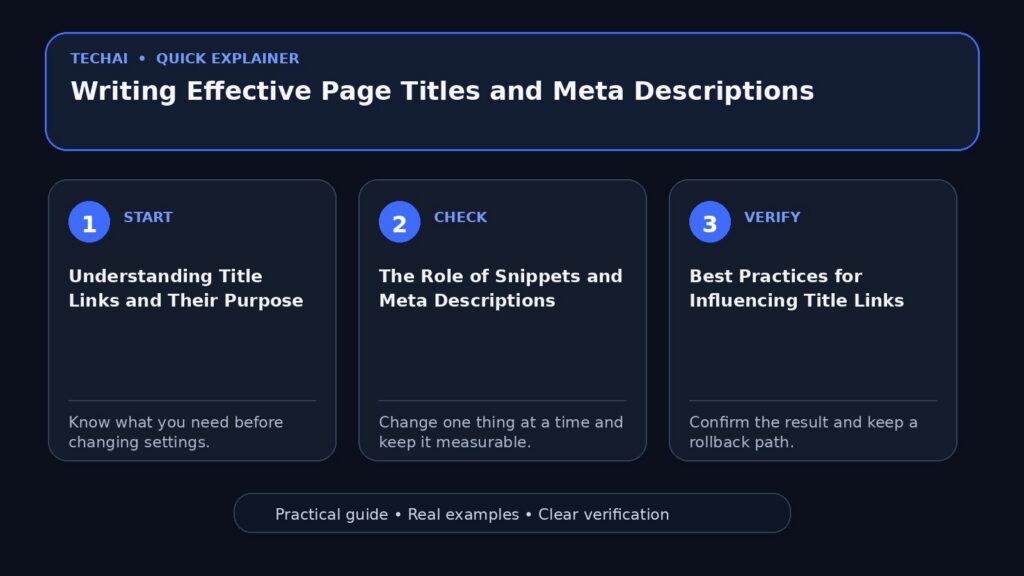
Understanding Title Links and Their Purpose
A title link is the clickable headline of a search result that appears on Google Search, Google News, and other properties. It serves as the first point of interaction between a potential visitor and your website. Google's automated systems determine this link by pulling from various sources, but the goal remains consistent: to provide users with a clear and concise summary of what the page offers. Because this link is the primary way users identify the relevance of a result, its clarity is paramount for maintaining a healthy click-through rate.

The process of influencing these links requires a balance between technical accuracy and descriptive writing. Google does not simply rely on a single HTML tag; it analyzes the entire page to ensure the title link accurately reflects the content. This means that even if you have a specific title in mind, the search engine may adjust it to better suit a user's specific search query. Understanding this dynamic nature of search appearance is the first step in moving away from rigid, keyword-heavy titles toward more fluid and descriptive language.
When title links are well-crafted, they provide immediate value. They should not be used as a place to dump keywords but rather as a tool for communication. A descriptive title helps the search engine categorize the page effectively within its index, while also giving the user the confidence that the page will answer their specific question or fulfill their current need.
- Title links are the primary clickable headlines in search results.
- Google uses multiple sources to automatically determine the link text.
- The main purpose is to give users quick insight into the page content.
- Links appear across various Google properties, including News and Search.
The Role of Snippets and Meta Descriptions
A snippet is the description or summary portion of a search result that appears below the title link. Its primary function is to provide additional context that the title link might not fully convey. Google primarily uses the actual content on the page to generate these snippets automatically. However, the meta description element remains a vital tool for website owners because Google may use it if it describes the page more accurately than other parts of the content.
Writing a meta description is essentially providing a pitch for your page. It should be a concise summary that highlights the unique value of the content. While Google cannot manually change snippets for individual sites, providing a high-quality meta description increases the likelihood that your preferred summary will be shown. This is especially important for pages where the on-page text might be technical or fragmented, making it difficult for an automated system to extract a clean summary.
It is important to note that snippets are dynamic. Depending on what a user searches for, Google might choose a different section of your page content to display as the snippet. By providing a well-written meta description, you offer a fallback option that can serve as a comprehensive overview of the page's intent, regardless of the specific keywords used in the search query.
- Snippets provide a summary or description of the search result.
- Google pulls snippet information primarily from the page content.
- Meta descriptions are used when they describe the page better than the content.
- Snippets are automatically generated and cannot be manually edited for individual sites.
Best Practices for Influencing Title Links
To influence how your title links appear, you must focus on being descriptive and concise. Avoid generic titles like 'Home' or 'Untitled,' as these provide no information to the user or the search engine. Instead, every page on your site should have a unique title that distinguishes it from other pages. This helps Google understand the structure of your site and ensures that users aren't confused by seeing multiple results with the same headline.
Another key practice is to avoid repetitive or 'boilerplate' text in your titles. While it might be tempting to include your brand name or a specific set of keywords on every page, this can lead to a poor user experience and may trigger spam filters. If a title is too long or contains too many repetitive elements, Google's systems may choose to truncate it or replace it entirely with a different title sourced from the page content, such as a prominent heading.
The goal is to create a title that acts as a clear label for the content. Think about what a user would need to know to decide if your page is the right one for them. If the page is a product description, the title should include the product name. If it is a blog post, the title should reflect the specific topic discussed. This level of specificity is what Google looks for when determining the most helpful title link to display.
- Use unique and descriptive titles for every page on your site.
- Avoid generic titles like 'Home' or 'New Page'.
- Minimize boilerplate text and repetitive branding.
- Ensure titles are concise enough to be read quickly in search results.
Avoiding Keyword Stuffing and Spam Policies
Keyword stuffing is the practice of filling a page title or meta description with a long list of keywords in an attempt to manipulate search rankings. This is not only ineffective but also violates Google's spam policies. Search engines are designed to identify and prioritize 'people-first' content—content created for the benefit of human users rather than for the purpose of ranking in search engines. When a title or description is stuffed with keywords, it becomes difficult for users to read and often fails to provide any real insight into the page.
Instead of focusing on keyword density, focus on the helpfulness and reliability of the information. Google's Search Essentials emphasize that content should be created to be helpful to the audience. A title that lists 'Cheap Shoes, Best Shoes, Buy Shoes, Shoes Online' is far less effective than one that says 'Affordable Running Shoes for Marathon Training.' The latter provides context and intent, which are much stronger signals for modern search algorithms.
Violating spam policies can lead to a decrease in search visibility or even removal from the index in extreme cases. By adhering to the principles of creating reliable content, you ensure that your site remains in good standing. This involves being honest about what the page contains and avoiding deceptive practices that try to trick the search engine into thinking a page is more relevant than it actually is.
- Keyword stuffing violates Google's spam policies.
- Focus on 'people-first' content rather than search engine manipulation.
- Avoid long lists of keywords that provide no descriptive value.
- Prioritize helpfulness and reliability in all metadata.
How Google Sources Search Appearance Data
Google's ability to generate title links and snippets comes from its sophisticated crawling and indexing process. When Googlebot visits a page, it looks at more than just the meta tags. It examines the main visual title (often the H1 tag), other heading elements, and even the text within links that point to the page. This holistic approach allows Google to create a search result that is as relevant as possible to the user's specific query.

Because Google uses multiple sources, it is possible for your search result to look different than what you have coded in your HTML. This usually happens if the automated system determines that a different piece of text on the page better represents the content for a particular search. For example, if a user searches for a specific sub-topic covered in your article, Google might pull a heading from that section to use as the title link to make the result more enticing to that specific user.
Understanding this should encourage you to maintain high-quality content throughout the entire page, not just in the metadata. Clear headings, descriptive anchor text, and well-structured paragraphs all contribute to how your site appears in search. By providing a variety of high-quality text signals, you give Google the best possible 'raw materials' to construct an effective search result.
- Googlebot analyzes the entire page, not just the meta tags.
- Headings (H1, H2, etc.) are often used as sources for title links.
- Anchor text from internal and external links can influence search appearance.
- Search results are dynamic and may change based on the user's query.
Technical Implementation of Meta Tags
From a technical standpoint, meta tags are placed in the `<head>` section of your HTML document. The `<title>` tag and the `<meta name="description" content="…">` tag are the two most important elements for influencing search appearance. While these tags do not guarantee exactly what will appear in search, they are the primary way you communicate your preferences to search engines. It is essential that these tags are correctly formatted and placed on every page of your site.
There are also more advanced attributes you can use to control how your content is used in snippets. For instance, the `data-nosnippet` attribute can be applied to specific HTML elements (like a `<span>` or `<div>`) to prevent Google from using that specific text in a search snippet. This is useful if you have parts of a page—such as a price list or a legal disclaimer—that you do not want appearing as the summary in search results.
Additionally, the robots meta tag can be used to provide instructions on how a page should be indexed. While this is a broader SEO tool, it impacts search appearance by determining whether a page is allowed to show a snippet at all. Ensuring your technical implementation is sound prevents errors that could lead to your site being displayed incorrectly or not at all in search results.
- Place title and meta description tags in the HTML <head> section.
- Use the data-nosnippet attribute to exclude specific text from snippets.
- Ensure every page has a unique and correctly formatted title tag.
- Use robots meta tags to control indexing and snippet display.
Monitoring Search Appearance with Search Console
Once you have implemented your titles and descriptions, the next step is to monitor how they are performing. Google Search Console is an essential tool for this, as it provides data on how often your site appears in search and how many users are clicking on your links. By analyzing traffic drops or increases, you can determine if your changes to titles and descriptions are having the desired effect on user behavior.
Search Console also allows you to see the specific queries that are bringing users to your site. If you notice that a page is ranking for a keyword that isn't reflected in its title link, you might consider updating the title to be more descriptive of that topic. This data-driven approach ensures that your SEO strategy is based on actual user behavior rather than guesswork. It also helps you identify if Google is frequently ignoring your meta descriptions in favor of other page content.
Furthermore, the tool can help you debug issues with crawling and indexing. If Google is unable to access your page or if there are technical errors in your meta tags, Search Console will alert you. Regularly checking these reports ensures that your site remains optimized and that your search appearance is as effective as possible.
- Use Search Console to monitor click-through rates and impressions.
- Analyze which queries are driving traffic to specific pages.
- Identify when Google is using page content instead of meta descriptions.
- Debug crawl errors that might affect how titles and snippets are generated.
Common Limitations and Expectations
It is important to manage expectations when it comes to SEO and search appearance. Google's goal is to provide the best experience for the searcher, which means their automated systems will always have the final say in what is displayed. You cannot 'force' a specific title link or snippet to appear; you can only influence the process by providing high-quality, descriptive signals. This is a fundamental aspect of how modern search engines operate.
Another limitation is the character count. While there is no hard limit on the length of a title or meta description, search results have limited physical space. If your title is too long, it will be truncated with an ellipsis (…). This is why being concise is a best practice. You want the most important information to be visible to the user immediately, without them having to guess what the rest of the sentence says.
Finally, remember that SEO is an ongoing process. As your content changes and as search algorithms evolve, you may need to revisit your titles and descriptions. What worked a year ago might not be as effective today. By staying informed through official documentation and monitoring your site's performance, you can adapt your strategy to ensure your site remains visible and attractive to users in an ever-changing search landscape.
- Google's automated systems have the final say on search appearance.
- Titles and snippets may be truncated if they are too long.
- SEO requires ongoing monitoring and periodic updates.
- The goal is to influence the system, not to control it absolutely.
Key takeaways
- Title links and snippets are automatically generated by Google using multiple sources.
- Meta descriptions are used as snippets when they describe the page better than the content.
- Descriptive, unique, and concise titles are essential for a good user experience.
- Keyword stuffing is a violation of spam policies and should be avoided.
- Search Console is the primary tool for monitoring and debugging search appearance.
Common mistakes to avoid
- Using generic or placeholder titles like 'Home' or 'Untitled'.
- Stuffing titles and descriptions with long lists of keywords.
- Using the same boilerplate text across every page of a website.
- Neglecting to provide a unique meta description for important pages.
Check your website next
- Check your website free
- Full Website Audit — $9
- Website Growth Bundle — $39
- Website Fix Implementation — from $149
FAQ
Why is Google showing a different title than the one I wrote?
Google uses various sources to determine the title link, including page headings and anchor text. If the automated system finds that a different piece of text better represents the page for a specific user query, it may choose to display that instead of your title tag.
Does every page need a meta description?
While not strictly required for indexing, it is a best practice to provide a unique meta description for every page. This gives Google a high-quality summary to use as a snippet if the on-page content doesn't provide a better description for the user's search.
How long should my page titles be?
There is no fixed character limit, but titles should be concise. If a title is too long for the search result space, Google may truncate it or automatically choose a shorter title from your page content to ensure it is readable.
Can I prevent certain text from appearing in my search snippet?
Yes, you can use the 'data-nosnippet' HTML attribute on elements like <span>, <div>, or <section> to instruct Google not to include that specific text in the search result snippet.