
Transforming a static SEO content brief into a polished, high-performing article requires more than just pasting requirements into a chatbot. By treating the AI as a collaborative partner, you can bridge the gap between technical keyword requirements and engaging, human-centric prose. This process relies on clear communication, where you define the persona, constraints, and structural expectations before the model begins drafting. Effective AI-assisted writing is an iterative cycle of prompt engineering, where the user provides natural language requests to elicit accurate, high-quality responses from a language model.
Rather than expecting a perfect draft in one go, you should break the brief into manageable components—such as outlines, section drafts, and tone adjustments. This guide explores how to leverage prompt design strategies to ensure your final output remains accurate, relevant, and aligned with your original SEO goals. By following a structured workflow that includes clear instructions, specific input types, and negative constraints, you can produce content that satisfies both search engine algorithms and human readers while maintaining brand consistency.
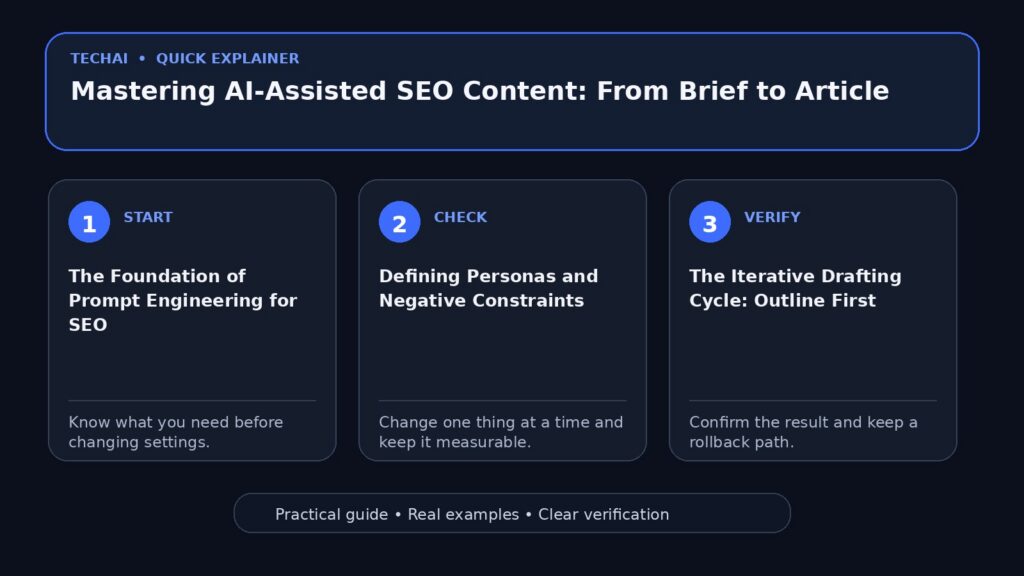
The Foundation of Prompt Engineering for SEO
Prompt engineering is the iterative process of creating natural language requests that elicit accurate, high-quality responses from a language model. When applied to SEO content creation, this means moving beyond simple commands and instead providing the model with a comprehensive framework. An effective prompt is not a one-time event but a starting point for experimentation and refinement based on the specific use case and the observed model responses. By understanding that generative models work like advanced auto-completion tools, you can better guide them to produce content that aligns with your specific SEO brief.

To get the most out of AI models like Gemini or GPT, you must provide clear and specific instructions. These instructions can take many forms, ranging from simple questions to complex step-by-step tasks that map out a user's experience and mindset. In the context of an SEO brief, this involves translating technical requirements—such as primary keywords, secondary keywords, and search intent—into actionable directives that the model can follow. The goal is to reduce the model's interpretation and ensure the output matches the intended structure and tone of the article.
One of the most efficient ways to customize model behavior is to provide it with context and examples. When you include examples of the desired output or the specific style you are aiming for, the model can take those into account during the generation process. This is particularly useful for SEO, where the balance between keyword density and readability is delicate. By providing a 'few-shot' prompt with a sample paragraph, you set a benchmark for the AI to follow, ensuring the final article feels cohesive and professionally written.
- Treat prompt engineering as an iterative cycle of refinement.
- Provide clear, specific instructions to reduce model interpretation.
- Use examples to set benchmarks for style and quality.
- Translate SEO technicalities into actionable natural language tasks.
Defining Personas and Negative Constraints
Before generating any text, you must establish the 'rules of engagement' for the AI. A brief often contains high-level goals, but the model needs specific constraints to avoid generic or repetitive language. By defining a clear persona—such as an expert industry analyst, a helpful technical guide, or a conversational blogger—you set the tone for the entire piece. This persona acts as a filter for the model's vocabulary and sentence structure, helping it avoid the 'robotic' feel often associated with AI-generated text.
Constraints are equally vital in the prompting process. You should explicitly tell the model what to do and, perhaps more importantly, what not to do. For instance, you can specify a constraint on how long a response should be or list specific jargon-heavy phrases that should be avoided. These negative constraints prevent the AI from drifting into filler content or using overused marketing clichés that can dilute the value of your SEO content. By setting these guardrails early, you ensure the output remains focused and professional.
In addition to tone and length, constraints can also cover structural requirements. You might instruct the model to avoid using passive voice or to ensure that every section ends with a transition to the next topic. This level of detail ensures that the AI-generated draft requires less manual editing later. When the model knows the boundaries of the task, it is much more likely to produce a response that fits the specific needs of your target audience and the requirements of your SEO brief.
- Establish a clear persona to guide tone and vocabulary.
- Use negative constraints to forbid specific phrases or clichés.
- Set length constraints for sections to ensure conciseness.
- Define structural rules like avoiding passive voice.
The Iterative Drafting Cycle: Outline First
The most effective way to use AI for long-form content is to build the article in stages. Start by feeding the SEO brief into the model and asking it to generate a detailed outline based on the target keywords and search intent. This is a 'task input' where the model operates on the entity of the brief to create a logical structure. Reviewing this outline is a critical step; it allows you to verify that the flow of information matches your expectations before any prose is written.
Generating an outline first prevents the model from losing focus, which often happens when it is asked to write a 2,000-word article in a single prompt. By breaking the project into subtasks, you maintain control over the narrative arc. If the outline misses a key secondary keyword or fails to address a specific user pain point mentioned in the brief, you can refine the prompt and ask for a revision. This iterative approach ensures the foundation of the article is solid before moving on to the drafting phase.
Once the outline is approved, it serves as a roadmap for the subsequent prompts. You can then ask the model to expand on each heading individually. This granular approach allows for 'mid-turn steering,' where you can adjust the direction of the content as it is being created. For example, if the first section is too technical, you can instruct the model to use simpler language for the second section. This level of oversight is impossible when generating the entire document at once.
- Start with an outline to verify logical flow and keyword placement.
- Break the writing process into manageable subtasks.
- Use the outline as a roadmap for granular section drafting.
- Refine the outline iteratively before generating full prose.
Section-by-Section Content Generation
After the outline is finalized, prompt the model to write one section at a time. This approach is highly effective because it allows you to provide specific feedback on each part of the article. For each section, you can provide the specific keywords that need to be included and the particular goal of that paragraph. This ensures that the AI maintains the correct focus and depth throughout the entire piece, rather than becoming repetitive or vague in the later stages of the draft.
When drafting section-by-section, you can use 'partial input completion' to guide the AI's writing style. By providing the first sentence or a specific opening phrase for a section, you can lead the model toward the desired tone. Generative models are designed to continue the context they are given; therefore, a strong, human-written opening can significantly improve the quality of the AI's continuation. This technique is particularly useful for maintaining a consistent brand voice across different parts of the article.
This granular method also makes it easier to incorporate data or specific examples. If a section feels too thin, you can ask the model for more examples or data-backed explanations without needing to regenerate the entire document. You can provide 'entity input'—such as a specific product feature or a statistic—and ask the model to integrate it into the current section. This ensures that the content is not just SEO-friendly but also genuinely useful and informative for the reader.
- Draft one section at a time to maintain focus and depth.
- Use partial input completion to guide the model's tone.
- Integrate specific keywords and data points into each section.
- Request additional examples for sections that feel thin.
Using Partial Input Completion for Style Matching
Partial input completion is a powerful strategy where you provide the model with a piece of text and ask it to continue or complete it. In the context of turning an SEO brief into an article, this can be used to ensure the AI matches your specific writing style. If you have a unique way of introducing topics or a specific cadence to your sentences, providing the first few sentences of a section can 'prime' the model to follow that pattern for the rest of the output.

This technique leverages the model's nature as an advanced auto-completion tool. When you provide context and a response prefix, the model takes those into account to produce a continuation that is stylistically consistent. For example, if you want a section to be formatted as a list of tips, you can start the list yourself and let the model complete the remaining items. This reduces the amount of manual editing required to make the AI's output match your brand's established voice.
Furthermore, partial input completion can be used to handle complex formatting requirements. If your SEO brief requires specific HTML tags or Markdown formatting, you can provide the opening tags and let the model fill in the content. This ensures that the output is not only high-quality in terms of text but also ready for immediate publication on your website. By guiding the model with partial inputs, you minimize the risk of the AI producing content that feels disconnected from the rest of your site.
- Provide a response prefix to prime the model for a specific style.
- Use partial inputs to maintain brand voice and cadence.
- Guide the model through complex formatting requirements.
- Leverage the model's auto-completion nature for better flow.
Refining Output with Task-Specific Instructions
When the AI produces a draft, it is rarely perfect on the first try. Use specific, task-oriented prompts to refine the output. Instead of asking the model to 'make it better,' which is vague and leaves too much to interpretation, provide actionable feedback. For example, you might say 'rewrite the second paragraph to be more concise' or 'add a bulleted list to explain the benefits of this feature.' This direct feedback helps the model understand exactly what needs to change.
This process of iterative refinement is the core of prompt engineering. By treating the model's output as a starting point rather than a final product, you maintain the human oversight necessary to ensure the content is accurate. You can also use 'entity classification' prompts to check your work. For instance, you can ask the model to list all the keywords it used in a section and classify them as primary or secondary to ensure you have met the requirements of the SEO brief.
Refinement also involves adjusting the tone for specific sections. While the overall article might be authoritative, you may want the conclusion to be more encouraging or the introduction to be more provocative. By providing these specific instructions during the refinement phase, you can create a more dynamic and engaging piece of content. Always remember that the model is a tool; your role is to steer it toward the best possible version of the article through clear, task-based communication.
- Provide actionable feedback instead of vague requests.
- Use task-oriented prompts for structural and tone adjustments.
- Verify keyword integration using entity classification.
- Iterate on the draft until it meets all brief requirements.
Managing Structured Data and Keyword Integration
SEO briefs often require more than just prose; they may include requirements for meta descriptions, schema markup, or specific JSON-LD structures. You can use the model's ability to generate structured outputs to handle these tasks. By providing a JSON schema or a specific format in your prompt, you can ensure the model returns data that is easy to use and technically accurate. This is much more reliable than asking for the information in natural language and then trying to format it yourself.
For keyword integration, you can instruct the model to provide a JSON object that lists the keywords used and their frequency. This allows you to quickly verify that the AI has followed the SEO brief without having to manually scan the entire article. Structured outputs reduce the size of the response and make it easier to integrate the AI's work into your existing content management system. This technical approach to prompting ensures that the 'SEO' part of the content brief is handled with precision.
Additionally, you can use structured prompts to generate metadata that aligns with the content of the article. By feeding the completed sections back into the model and asking for a 150-character meta description that includes the primary keyword, you ensure consistency between the page content and its search engine snippet. This holistic approach to using AI ensures that every element of the SEO brief—from the body text to the underlying code—is addressed systematically.
- Use structured outputs (JSON) for technical SEO requirements.
- Generate meta descriptions and schema markup with specific prompts.
- Verify keyword frequency using structured data responses.
- Ensure consistency between body text and metadata.
Quality Control and Human-in-the-Loop Review
The final and most important step in turning an SEO brief into a useful article is the human review. While AI models are incredibly capable, they are still 'generative language models' that work based on probability. They can occasionally produce factual errors or 'hallucinations.' Therefore, a human editor must verify all data points, names, and technical claims against reliable sources. This 'human-in-the-loop' approach is essential for maintaining the credibility of your brand and the accuracy of your content.
Beyond fact-checking, human review is necessary to ensure the content truly resonates with the target audience. An AI might follow the SEO brief perfectly but still produce text that feels slightly 'off' or lacks the nuance of a human expert. Editors should look for opportunities to add unique insights, personal anecdotes, or industry-specific context that a model might not have access to. This adds the 'E-E-A-T' (Experience, Expertise, Authoritativeness, and Trustworthiness) that search engines value.
Finally, use the AI to help with the final polish. You can prompt the model to check for grammatical errors, suggest more engaging headlines, or ensure that the transition between sections is smooth. By using the AI as a final proofreader, you can catch minor issues that might have been missed during the drafting process. This collaborative effort between human and AI results in an article that is not only optimized for search engines but is also a high-quality, useful resource for your readers.
- Verify all factual claims and data points manually.
- Add human nuance and unique insights to improve E-E-A-T.
- Use AI as a final proofreader for grammar and transitions.
- Ensure the final output aligns with brand credibility.
Key takeaways
- Treat AI as a collaborative partner that requires iterative prompt engineering.
- Break complex SEO briefs into smaller subtasks like outlines and sections.
- Use clear, specific instructions and negative constraints to guide the model.
- Leverage partial input completion to maintain a consistent brand voice.
- Always maintain human oversight for factual accuracy and quality control.
Common mistakes to avoid
- Providing vague instructions like 'write a good article' without context.
- Expecting a perfect, final draft from a single, one-shot prompt.
- Failing to define negative constraints, leading to repetitive or generic filler.
- Ignoring the need for human fact-checking and editorial refinement.
Check your website next
- Check your website free
- Full Website Audit — $9
- Website Growth Bundle — $39
- Website Fix Implementation — from $149
FAQ
How do I ensure the AI follows my SEO keyword requirements?
Include your keyword list in the initial prompt and instruct the model to integrate them naturally. You can also ask the model to provide a structured JSON list of where it placed each keyword after the draft is complete to verify compliance.
Is it better to generate the whole article at once or in parts?
It is significantly better to generate the article section by section. This prevents the model from losing focus, allows for mid-turn steering, and ensures that each part of the brief is addressed with the necessary depth and accuracy.
What should I do if the AI's tone is too robotic or generic?
Provide a sample of your preferred writing style or use a 'response prefix' to guide the model's opening. Additionally, use negative constraints to explicitly forbid common AI-sounding words and phrases that contribute to a robotic tone.