
The primary challenge in using artificial intelligence for content planning is not the generation of ideas, but the prevention of 'filler'—generic, low-value text that fails to engage a specific audience. Most users approach AI with vague requests, resulting in repetitive schedules that lack brand voice or strategic depth. To build a truly effective 30-day plan, you must move beyond simple chat interactions and adopt a rigorous prompt engineering framework that treats the AI as a precision tool rather than a magic wand.
By leveraging official strategies from leading AI developers like OpenAI and Google, you can implement structured outputs, few-shot prompting, and specific constraints to ensure every piece of content serves a purpose. This guide explores how to define clear instructions, utilize different input types, and apply iterative refinement to transform a basic prompt into a sophisticated editorial engine. The goal is to produce a month of content that feels human-curated and strategically aligned with your specific business objectives.
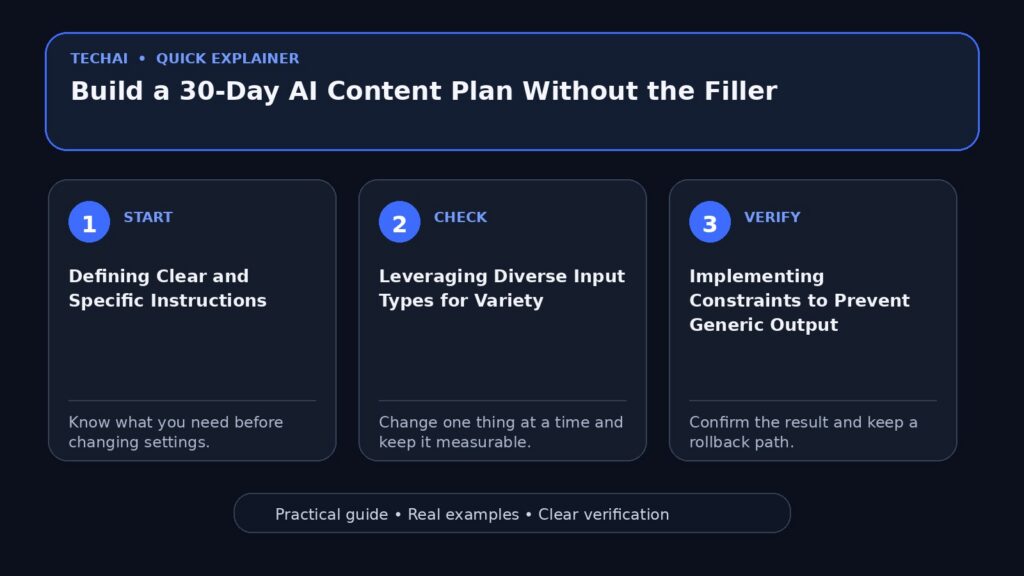
Defining Clear and Specific Instructions
The foundation of any high-quality content plan is the clarity of the initial instruction. According to official prompt engineering guidelines, an effective way to customize model behavior is to provide instructions that are as complex as mapping out a user's experience and mindset. Instead of asking for '30 social media posts,' you should define the persona, the specific goal of the campaign, and the step-by-step tasks the model must perform to reach that goal.

Specificity acts as a filter for quality. When the model understands the exact context—such as the target audience's pain points or the specific stage of the marketing funnel—it is less likely to fall back on generic platitudes. You should explicitly state the 'why' behind the content plan, ensuring the AI understands the strategic intent before it begins generating individual topics.
- Define the persona and mindset of the target reader.
- Provide a step-by-step breakdown of the planning process.
- State the primary objective (e.g., lead generation vs. brand awareness).
- Specify the desired tone and professional level of the output.
Leveraging Diverse Input Types for Variety
To avoid a repetitive 30-day plan, you must vary the types of inputs you provide to the model. Official documentation categorizes inputs into four primary types: question, task, entity, and completion. A robust content plan should utilize all four. For example, use 'question inputs' to have the AI brainstorm what your audience is currently asking, and 'task inputs' to convert those questions into specific article outlines.
Entity classification is particularly useful for organizing a calendar. You can provide a list of raw ideas and ask the model to classify them as 'Educational,' 'Promotional,' or 'Engagement-focused.' This ensures a balanced mix of content throughout the month. Partial input completion, where you provide the start of a content idea and let the model finish it, can also help maintain your unique brand perspective while using the AI for creative expansion.
- Question Input: Identify common industry problems to solve.
- Task Input: Generate specific headlines and meta-descriptions.
- Entity Input: Categorize content pillars to ensure variety.
- Completion Input: Start a unique thought and let the AI expand it.
Implementing Constraints to Prevent Generic Output
Constraints are the most powerful tool for eliminating filler. You must tell the model not only what to do but also what not to do. This includes setting limits on length, forbidding specific overused 'AI-isms' (like 'In the fast-paced world of…'), and enforcing structural requirements. By specifying constraints, you force the model to work within a narrower, more creative space that aligns with your brand standards.
When building a 30-day plan, constraints should be applied to the entire calendar. For instance, you might constrain the model to ensure no two consecutive days cover the same topic, or that every Friday post must include a call-to-action for a specific product. This level of control prevents the 'drifting' effect where the AI becomes increasingly repetitive over a long sequence of generations.
- Set strict character or word counts for each post type.
- List 'forbidden words' that contribute to a generic tone.
- Enforce a specific ratio of content types (e.g., 40% educational).
- Require specific formatting, such as bullet points or numbered lists.
Using Few-Shot Prompting for Brand Voice
Few-shot prompting involves providing the model with several examples of high-quality content before asking it to generate new ideas. This is significantly more effective than simply describing your brand voice in adjectives. By showing the AI 3-5 examples of your best-performing past content, you provide a template for the style, rhythm, and vocabulary you expect.

In the context of a 30-day plan, few-shot prompting helps the model understand the 'delta' between a generic post and a brand-specific one. If the model sees that your brand uses data-driven insights and a dry, witty tone, it will attempt to replicate those patterns in the new calendar. This reduces the need for heavy manual editing after the plan is generated.
- Provide 3-5 examples of successful past content.
- Include both the 'input' (topic) and 'output' (finished post).
- Use response prefixes to guide the model's initial sentences.
- Highlight specific stylistic elements you want the AI to mimic.
Utilizing Structured Output for Organization
A 30-day plan is a complex data set that is best managed through structured outputs like JSON or Markdown tables. Official guides recommend using structured output features to ensure the model returns data in a predictable format. This allows you to easily export the plan into project management tools or spreadsheets without manual reformatting.
By defining a JSON schema for your content plan, you can require the model to provide specific fields for every day, such as 'Date,' 'Topic,' 'Key Points,' 'Platform,' and 'Visual Idea.' This structure prevents the AI from rambling and ensures that every entry in the 30-day plan contains all the necessary information for execution.
- Request output in JSON or Markdown table format.
- Define specific fields (e.g., Headline, CTA, Keywords).
- Use schemas to ensure the model doesn't omit required data.
- Omit unnecessary fields to keep the response concise.
The Iterative Refinement Cycle
Prompt engineering is inherently iterative. You should not expect a perfect 30-day plan from a single prompt. Instead, use an optimization cycle: generate a draft, evaluate it against your quality standards, and refine the prompt based on the observed errors. If the AI produces filler on day 15, analyze why the prompt allowed that to happen and add a new constraint to fix it.
This cycle is essential for long-term content strategy. As you refine your prompts over several months, you build a 'prompt library' that consistently produces high-quality results. Official documentation suggests using 'evals' or graders to objectively measure how well the model is following your instructions, which can be as simple as a checklist of your brand's quality requirements.
- Generate a small sample (e.g., 3 days) before the full 30.
- Identify specific 'filler' patterns in the initial output.
- Update the prompt with new constraints or examples.
- Re-run the generation and compare the results.
Grounding Content in Real-World Context
One of the biggest causes of low-quality AI content is a lack of grounding in current facts or specific data. To combat this, utilize tools like 'Deep Research,' 'Web Search,' or 'URL context' if your AI platform supports them. By providing the model with access to your latest whitepapers, industry news, or competitor analysis, you ensure the 30-day plan is based on reality rather than just statistical probability.
Grounding also involves providing the model with 'files' or 'retrieval' data. If you upload a PDF of your annual marketing strategy, the AI can align the 30-day plan with your actual business milestones. This transforms the output from a generic list of ideas into a tailored strategic document that supports your real-world operations.
- Use web search tools to find trending industry topics.
- Upload internal strategy documents for context.
- Provide URLs of high-quality sources for the AI to reference.
- Ensure the AI cites its sources to prevent hallucinations.
Limitations and Human Oversight
Despite the power of advanced prompting, AI models have limitations in reasoning and long-term consistency. A 30-day plan generated in one go may suffer from 'context drift,' where the later days lose the focus established in the beginning. It is often more effective to generate the plan in weekly blocks or to use a 'reasoning model' that can handle more complex, multi-step planning tasks.
Human oversight remains the final filter for quality. The AI can handle the heavy lifting of drafting and organizing, but a human editor must review the plan for cultural nuance, brand sensitivity, and strategic alignment. The goal of using AI is to reach the 90% mark faster, allowing humans to spend their energy on the final 10% that truly differentiates the content.
- Break 30-day plans into smaller, manageable blocks.
- Use reasoning-heavy models for complex strategy tasks.
- Review every output for 'context drift' or repetition.
- Manually inject unique personal anecdotes or proprietary data.
Key takeaways
- Specificity in instructions is the primary defense against generic filler.
- Use few-shot prompting with real brand examples to anchor the AI's style.
- Structured outputs (JSON/Markdown) keep the 30-day plan organized and actionable.
- Constraints must include both 'what to do' and 'what to avoid' to maintain quality.
- Ground the AI in real-world data using search tools or uploaded files.
Common mistakes to avoid
- Using single-sentence prompts that lack context or strategic goals.
- Accepting the first draft without going through an iterative refinement cycle.
- Failing to provide examples of the desired brand voice and tone.
- Generating 30 days of content in a single prompt, leading to context drift.
Useful TechAI links
FAQ
How do I stop the AI from sounding like a robot?
Use few-shot prompting by providing 3-5 examples of your best human-written content. Additionally, set negative constraints to forbid common AI phrases and 'filler' words.
Can AI handle a full 30-day calendar in one prompt?
While possible, it often leads to repetition. It is better to use a structured output (like a JSON schema) or generate the plan in 7-day increments to maintain high quality and focus.
How do I ensure the content is factually accurate?
Use grounding techniques such as 'Web Search' or 'File Search' to provide the model with official sources, whitepapers, or current news to reference during the planning process.