
Freelancing can become a real source of income, but it is not an instant-money system. A stronger starting point is to choose a service you can demonstrate, build evidence of your work, and learn how to define scope and communicate clearly with clients.
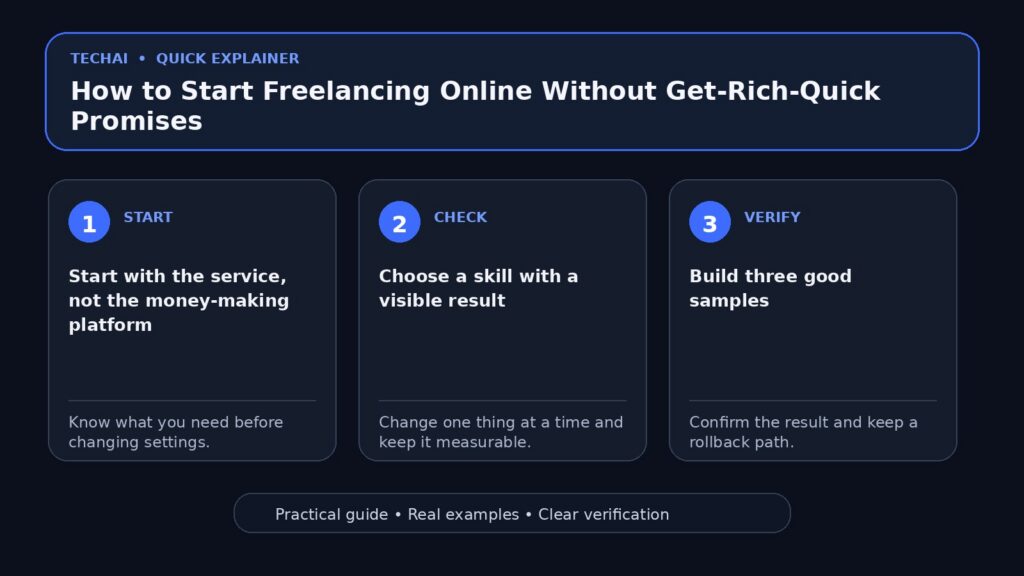
Start with the service, not the money-making platform
Before choosing a marketplace, decide what you can actually deliver: editing short videos, building a simple website, designing social posts, translating, writing documentation, cleaning data, or another concrete outcome.
Choose a skill with a visible result
It is easier to earn trust when a client can see what “done” looks like. A before-and-after example, working demo, sample design, or short case study is more convincing than a long list of skills.
Build three good samples
You do not need dozens of portfolio items. Create a few samples that represent the kind of work you want to sell. If they are self-initiated examples, label them honestly rather than presenting them as paid client work.
Write a customized proposal
Show that you understood the request. Summarize the problem, explain the deliverable, mention the timeline, and ask only the questions that affect scope. Avoid sending the same generic paragraph to every client.
Define scope before price
A “website” or “video” can mean very different amounts of work. Clarify deliverables, revisions, deadlines, source files, and responsibilities before agreeing on a fixed price.
Do not pay for an unknown job
Be cautious when a stranger requires a payment, gift card, crypto transfer, equipment fee, or unrelated purchase before you can “start work.” Verify the platform and the client independently.
Do not share credentials without a real need
Use limited-access accounts, collaborator roles, or temporary credentials when possible. A client should not need your personal email password, recovery codes, or unrelated account access.
Treat free tests carefully
A small test can be reasonable, but a large “test” that produces a finished commercial deliverable may simply be unpaid work. Agree on what the test covers before starting.
How should you price at the beginning?
There is no universal beginner rate. Estimate the time, complexity, revision risk, platform fees, and value of the deliverable. Your first projects can be modest without being free or unsustainably cheap.

Use a clear agreement even for small projects
Write down the deliverable, deadline, price, number of revisions, payment terms, and what is outside scope. A short written agreement prevents many misunderstandings.
Keep copies and backups
Maintain your own organized copy of project files, approved versions, and important messages. Do not rely on one chat thread or one device as the only record of the work.
AI is a tool, not a replacement for the skill
AI can help draft proposals, organize research, create checklists, or speed repetitive steps, but you still need to understand the deliverable well enough to review the output and take responsibility for it.
Common warning signs
- Pressure to move immediately to an unknown payment method.
- Requests for passwords or verification codes.
- Promises of unusually high pay for trivial work.
- Large unpaid “tests.”
- Unclear scope combined with a fixed deadline and unlimited revisions.
A practical first two weeks
- Choose one service.
- Create three portfolio samples.
- Write a short service description and proposal template.
- Set a simple scope and revision policy.
- Apply only to work that matches your current ability.
- Track what clients ask for and improve the service from real feedback.
When should you expand your services?
Expand when you can deliver the current service consistently and customers repeatedly ask for a related outcome. Adding every possible service too early makes your offer harder to explain and harder to deliver well.
Use technology to reduce admin work, not to make promises
Automation can help with scheduling, templates, file organization, and repetitive communication. It should not be used to promise deadlines or capabilities you cannot actually deliver.
A first-client workflow you can repeat
Use the same small process for every early project so you do not rely on memory or chat messages.
- Write the deliverable in one sentence and define what is not included.
- Agree on the deadline, number of revisions, price, and delivery format.
- Keep source files and client-provided assets in a project folder.
- Send a preview or checkpoint before the final delivery when the work is large enough to justify it.
- After delivery, record what took the most time and update your next quote.
A repeatable workflow makes a small freelance service look more professional and helps you price future work using evidence instead of guesses.
Conclusion
A sustainable freelancing start is built on a visible skill, a small portfolio, clear scope, careful communication, and safe payment practices. Focus on making one service dependable before trying to scale it.