As cyber threats evolve with increasing speed and intelligence, organizations must move beyond basic compliance to active defense. The Cybersecurity and Infrastructure Security Agency (CISA) has released its 2026 Cybersecurity Awareness Month resources, specifically designed to help organizations of all sizes—from small businesses to critical infrastructure operators—build effective internal campaigns. These resources focus on the 'Secure Our World' initiative, emphasizing four core behaviors that significantly reduce digital risk for employees and the enterprise alike.
Building a campaign using official government resources provides a standardized, authoritative framework that resonates with stakeholders. By utilizing the 2026 Toolkit and CISA’s no-cost cyber hygiene services, your organization can address modern challenges like Super Intelligence-driven hacking and system disruptions. This guide outlines how to implement these tools to create a culture of security that protects your customers, data, and critical operations.
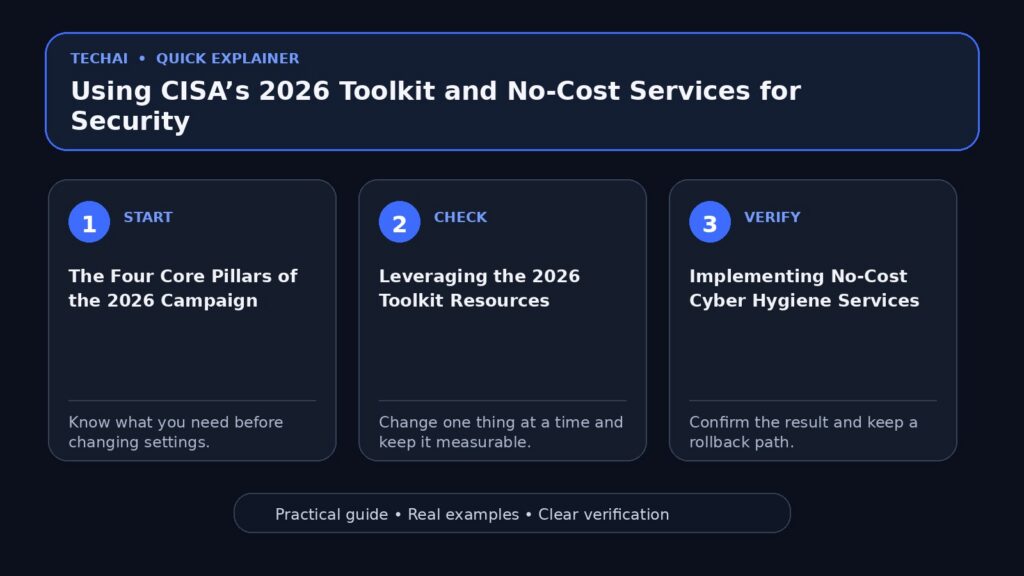
The Four Core Pillars of the 2026 Campaign
The foundation of the CISA 2026 campaign rests on four essential actions that every individual in your organization should master. These are not just suggestions; they are the primary defense mechanisms against the most common entry points for hackers. By focusing your internal messaging on these specific areas, you avoid overwhelming staff with technical jargon and provide clear, actionable steps. The first two pillars involve identity management: using strong passwords and implementing multifactor authentication (MFA) alongside a password manager. These tools ensure that even if one credential is leaked, the entire network isn't compromised.

The latter two pillars focus on vigilance: recognizing and reporting phishing scams and keeping all software updated to patch vulnerabilities that hackers exploit. In an era where Super Intelligence is accelerating the rate at which hackers find weak spots, these basic hygiene steps are more critical than ever. Organizations are encouraged to move beyond individual responsibility by mandating these practices at the enterprise level, ensuring that every workstation and mobile device is a hardened point of defense rather than a vulnerability.
To implement these pillars effectively, organizations should establish a clear, one-click process for employees to report suspicious emails. This not only helps the IT team identify active threats but also reinforces a culture of shared responsibility. Furthermore, automating software updates across the fleet ensures that critical patches are applied without relying on manual user intervention, which is often the weakest link in a security chain.
- Mandate or strongly encourage the use of enterprise password managers.
- Enable MFA on all business applications, especially email and remote access.
- Establish a clear, one-click process for employees to report suspicious emails.
- Automate software updates across all workstations and mobile devices.
Leveraging the 2026 Toolkit Resources
CISA provides a comprehensive 2026 Toolkit that removes the guesswork from campaign creation. This toolkit includes professionally designed graphics, ready-to-use presentations, and messaging templates tailored for different audiences. Instead of starting from scratch, your communications team can adapt these resources to fit your corporate branding while maintaining the integrity of the security advice. This allows even small organizations with limited marketing budgets to deploy high-quality, authoritative security awareness materials.
The toolkit is particularly useful for organizations that lack a dedicated cybersecurity training department. It includes specific resources for kids and families, such as puzzles and postcards, which can be shared with employees as a value-add benefit. Helping employees secure their home lives often leads to better security habits in the workplace, creating a holistic environment of digital safety. When employees understand how to protect their personal data and families, they are more likely to apply those same principles to organizational data.
To maximize the impact of the toolkit, align your internal calendar with Cyber Careers Week, which runs from October 19 to 24, 2026. This week is dedicated to exploring, inspiring, and connecting individuals with the diverse roles available in the cybersecurity field. By using the toolkit's 'Explore. Inspire. Connect.' theme, you can demystify the technical aspects of security and encourage staff from all departments—including HR, finance, and marketing—to see themselves as vital contributors to the organization's defense.
- Download the official 2026 Toolkit from CISA.gov to access high-resolution graphics.
- Use the pre-made presentations for 'Lunch and Learn' sessions with staff.
- Distribute digital postcards and puzzles to engage employees' families.
- Align your internal calendar with Cyber Careers Week (October 19-24, 2026).
Implementing No-Cost Cyber Hygiene Services
Beyond educational materials, CISA offers no-cost cyber hygiene services that provide technical validation of your security posture. These services are designed to help organizations identify vulnerabilities before they can be exploited by malicious actors. For small and medium-sized businesses that may not have the budget for expensive third-party audits, these government-provided services are an essential resource for maintaining a baseline of security. They provide an external perspective on what a hacker might see when scanning your network.
These services typically include vulnerability scanning and web application scanning. By participating, your organization receives regular reports on its internet-facing assets, highlighting 'weak spots' that need immediate attention. This proactive approach is a key component of the 'Secure Our World' initiative, moving the organization from a reactive state to a resilient one. It allows IT teams to prioritize their limited time on the vulnerabilities that pose the greatest risk to the organization's operations.
In addition to scanning, organizations should actively use the Known Exploited Vulnerabilities (KEV) Catalog provided by CISA. This catalog is a living document of vulnerabilities that are known to be used by attackers in the wild. By cross-referencing your scan results with the KEV Catalog, you can ensure that your team is patching the most dangerous holes first. This risk-based approach to vulnerability management is far more effective than trying to patch everything at once without a clear strategy.
- Sign up for CISA’s vulnerability scanning to monitor internet-accessible assets.
- Review the KEV (Known Exploited Vulnerabilities) Catalog to prioritize patching.
- Utilize logging on all systems to track potential unauthorized access.
- Request a CISA speaker for major organizational security events.
The 3Rs for Critical Infrastructure
For organizations that own or operate critical infrastructure, CISA introduces the '3Rs' framework: Reduce, Replace, and Recover. This framework is designed to address the unique risks associated with industrial control systems and essential services that the nation relies upon. It emphasizes the physical and digital resilience required to sustain operations during a disruption, acknowledging that total prevention is not always possible in a complex, interconnected environment.

The first step, 'Reduce,' focuses on shrinking the attack surface by eliminating unnecessary access points and disabling unused ports or services. 'Replace' addresses the danger of end-of-support (EoS) devices, which no longer receive security updates and are prime targets for hackers. CISA's Binding Operational Directive (BOD) 26-02 specifically mandates the mitigation of risk from these end-of-support edge devices, as they often serve as the initial entry point for sophisticated attacks.
Finally, 'Recover' ensures that the organization has a tested incident response plan to restore services quickly after an attack. This involves not just technical backups, but also the organizational processes required to maintain operations during a system disruption. By practicing these 3Rs, critical infrastructure operators can ensure they are prepared for the 'Super Intelligence' threats that are accelerating the pace of modern cyber warfare.
- Reduce attack surfaces by disabling unused ports and services.
- Replace end-of-support edge devices as mandated by BOD 26-02.
- Prioritize security updates based on risk levels defined in BOD 26-04.
- Develop and regularly test a comprehensive incident response plan.
Addressing Evolving Threats and Super Intelligence
The 2026 guidance specifically highlights the acceleration of threats due to 'Super Intelligence' and evolving technology. Hackers are now using advanced tools to find vulnerabilities faster than ever before, meaning that traditional, slow-moving security updates are no longer sufficient to protect sensitive data and national infrastructure. This shift requires a more dynamic approach to security, where organizations are constantly monitoring for new threats and responding in real-time.
To combat this, CISA recommends a policy framework that includes AI safety and quantum innovation readiness. Organizations should stay informed through CISA Live! events and recorded sessions that discuss how to build resilience against these high-tech threats. Understanding the intersection of AI and cybersecurity is now a requirement for modern IT leadership, as these technologies will define the next frontier of both attacks and defenses.
Furthermore, the White House has issued Executive Orders focused on ensuring a national policy framework for Artificial Intelligence and ushering in the next frontier of quantum innovation. Organizations should review these directives to align their internal policies with national security goals. This includes implementing encrypted data storage to protect against future decryption threats and ensuring that AI systems are deployed with a 'Secure AI Framework' in mind.
- Monitor CISA alerts and advisories for real-time threat intelligence.
- Review White House Executive Orders on AI and Quantum Innovation.
- Attend 'CI Fortify' webinars to learn about rapid recovery techniques.
- Implement encrypted data storage to protect against future decryption threats.
Securing SLTT and Small Business Environments
State, Local, Tribal, and Territorial (SLTT) governments, along with small businesses, are frequent targets because they often manage sensitive community data with limited resources. CISA’s 2026 resources include specific tracks for these entities to help them safeguard operations and prevent disruptions that could endanger public safety. For these organizations, the focus is on building a strong foundation of security that can withstand the pressure of modern digital threats.
For these organizations, getting a '.gov' domain is a highly recommended step if eligible. A .gov domain signals to the public that the website is an official, secure government entity, which helps prevent spoofing and builds trust. Because .gov domains are restricted to official U.S. government organizations, they provide a layer of verification that commercial domains cannot match. This is a simple but effective way to protect the organization's reputation and ensure citizens are interacting with legitimate services.
Additionally, small businesses are encouraged to back up all data and use encryption to protect customer information from ransomware. Having an incident response plan in place and reporting all cyber incidents to CISA are also vital steps. Reporting incidents helps CISA build a national picture of the threat landscape, which in turn allows them to provide better guidance and resources back to the community. Small businesses are the backbone of the economy, and their security is a matter of national resilience.
- Apply for a .gov domain to increase organizational legitimacy and security.
- Ensure all data is backed up in an off-site or cloud-based location.
- Encrypt sensitive data both at rest and in transit.
- Report all cyber incidents to CISA to help build national threat awareness.
Building a Career-Focused Security Culture
Cybersecurity is not just a technical challenge; it is a human one. During Cybersecurity Career Week (October 19-24, 2026), organizations should highlight that security needs innovators, communicators, and problem-solvers from all backgrounds. By encouraging employees to see themselves as part of the security solution, you can foster a more vigilant workforce that acts as a human firewall against social engineering and phishing attempts.
This approach helps demystify cybersecurity and encourages staff to take ownership of their digital habits. Whether an employee is in marketing, HR, or finance, their role in protecting the organization's data is vital. Using the 'Explore. Inspire. Connect.' theme can help recruit internal 'security champions' who lead by example and help their colleagues navigate the complexities of digital safety. This cultural shift is essential for long-term resilience.
Organizations can host internal workshops or 'Fireside Chats' during this week to discuss the various career paths within cybersecurity. Highlighting that the field needs more than just technical experts—it needs analysts, designers, and educators—can help attract a more diverse range of talent to the security mission. By investing in the people who make up the organization, you create a sustainable security posture that evolves alongside the threats.
- Host internal workshops during Cybersecurity Career Week.
- Identify and reward employees who consistently report phishing attempts.
- Promote diverse roles within the cybersecurity field to all staff.
- Use CISA’s 'Cyber Careers' resources to inspire non-technical staff.
Key takeaways
- Focus on four core actions: MFA, strong passwords, software updates, and phishing awareness.
- Utilize the 2026 Toolkit for ready-made graphics and presentation materials.
- Apply the 3Rs (Reduce, Replace, Recover) if operating critical infrastructure.
- Leverage CISA’s no-cost vulnerability scanning and hygiene services.
- Adopt a .gov domain for SLTT organizations to enhance trust and security.
Common mistakes to avoid
- Relying on passwords alone without implementing multifactor authentication.
- Using end-of-support (EoS) devices that no longer receive critical security patches.
- Failing to report cyber incidents to CISA, which hinders national threat response.
- Treating cybersecurity as a purely technical issue rather than an organizational culture shift.
Check your website next
- Check your website free
- Full Website Audit — $9
- Website Growth Bundle — $39
- Website Fix Implementation — from $149
FAQ
What are the 3Rs of Cybersecurity mentioned by CISA?
The 3Rs stand for Reduce, Replace, and Recover. They involve reducing the attack surface, replacing end-of-support devices, and ensuring the ability to recover quickly to sustain operations during disruptions.
Who can use CISA's no-cost cyber hygiene services?
These services are available to organizations of all sizes, including small and medium businesses, state and local governments, and critical infrastructure owners to help identify and mitigate vulnerabilities.
When is Cybersecurity Career Week 2026?
Cybersecurity Career Week is scheduled for October 19 – 24, 2026. It is a time to explore, inspire, and connect individuals with the diverse roles available in the cybersecurity field.
Why is a .gov domain recommended for certain organizations?
A .gov domain is restricted to official U.S. government organizations. It provides a layer of trust and security, making it harder for attackers to impersonate official services.