As cyber threats evolve with increasing speed and sophistication, organizations—particularly those managing critical infrastructure—face significant risks from aging hardware. The Cybersecurity and Infrastructure Security Agency (CISA) has introduced the '3Rs' framework—Reduce, Replace, and Recover—specifically designed to address the vulnerabilities inherent in end-of-support (EOS) edge devices. These devices, which often sit at the perimeter of a network, become primary targets for hackers when they no longer receive security updates or manufacturer support. New and evolving technology, such as Super Intelligence, is accelerating the rate at which hackers can find and take advantage of weak spots in computer software and systems, putting the national economy at risk.
Implementing the 3Rs is not merely a technical upgrade path but a strategic approach to risk management. By focusing on shrinking the attack surface, phasing out obsolete hardware, and ensuring rapid operational restoration, businesses can protect their data and the essential services they provide. This guide explores the practical application of CISA’s directives, including Binding Operational Directive (BOD) 26-02, to help your organization stay secure in an era of accelerating digital threats. Organizations of all sizes can take additional steps such as using logging, backing up data, and encrypting information to build a comprehensive defense against system disruptions.
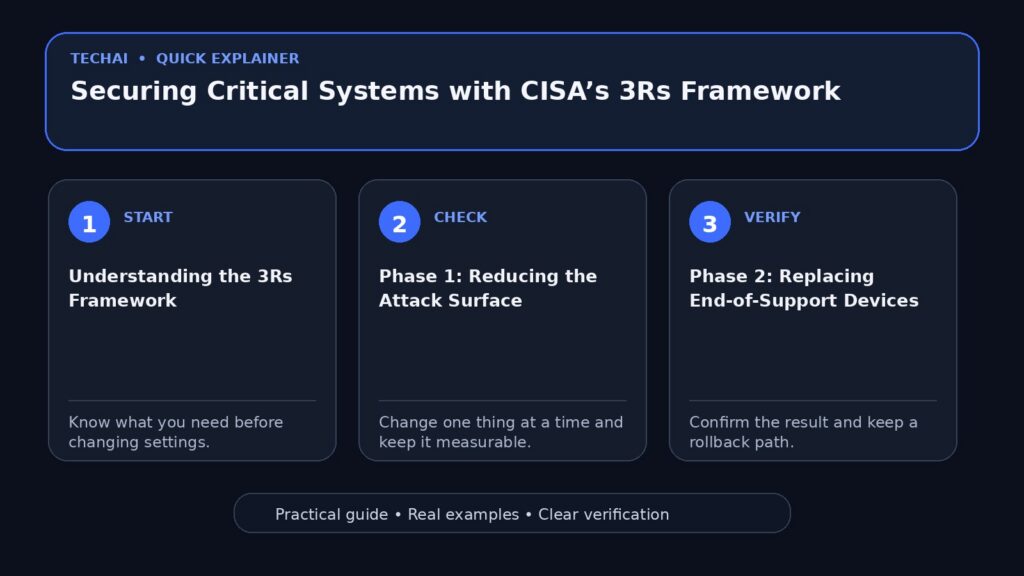
Understanding the 3Rs Framework
The 3Rs framework—Reduce, Replace, and Recover—is a specialized cybersecurity strategy promoted by CISA to help organizations manage the lifecycle of their technology, especially edge devices. Edge devices are hardware components like routers, firewalls, and gateways that connect internal networks to the internet. When these devices reach 'end-of-support' status, they stop receiving critical security patches, making them permanent 'weak spots' that hackers can exploit to gain entry into a system. Because these devices are internet-facing, they represent the first line of defense and the first point of attack for malicious actors.

The framework is designed to be actionable for organizations of all sizes, from small businesses to large-scale critical infrastructure operators. It moves beyond basic cyber hygiene by focusing on the physical and logical presence of hardware within the environment. By following this structured approach, IT teams can prioritize their security investments where they will have the most significant impact on national and organizational security. This is particularly important for those who own or operate critical infrastructure, as they play a significant role in national security, a thriving economy, and public safety.
CISA emphasizes that the 3Rs are not just about prevention but about resilience. The framework acknowledges that the threat landscape is changing, with new technologies making it easier for attackers to find vulnerabilities. By adopting a lifecycle-based approach to hardware, organizations can ensure they are not leaving 'doors' open to their network simply because they are using outdated equipment. This strategic alignment helps organizations move from a reactive posture to a proactive one, ensuring that every piece of equipment on the network perimeter is capable of receiving modern security protections.
- Reduce: Minimize the number of entry points and the overall attack surface.
- Replace: Transition away from end-of-support devices that lack security updates.
- Recover: Build systems that can sustain operations and restore quickly after a disruption.
- Focus: Prioritize edge devices that are most vulnerable to external exploitation.
Phase 1: Reducing the Attack Surface
The first pillar, Reduce, focuses on eliminating unnecessary exposure. Every device connected to the internet represents a potential doorway for an attacker. CISA recommends that organizations conduct a thorough inventory of their network to identify every edge device and determine if its internet-facing functionality is strictly necessary for business operations. Reducing the attack surface is the most cost-effective way to improve security because it removes the target entirely rather than just hardening it.
Reducing the attack surface often involves disabling unused services or decommissioning devices that no longer serve a vital purpose. For devices that must remain active, implementing strict access controls and logging is essential. This phase is about simplification; the fewer devices you have exposed to the public internet, the smaller the target you present to malicious actors. Organizations should also consider using a .gov domain if eligible, as this ensures official and secure communication channels that are easier for users to verify.
Practical steps in this phase include auditing all internet-facing hardware to identify end-of-support status and disabling non-essential services and ports on all active edge devices. Robust logging should be implemented to monitor for unauthorized access attempts. By shrinking the digital footprint, an organization limits the number of 'weak spots' that Super Intelligence or automated scanning tools can find. This phase sets the foundation for the more resource-intensive 'Replace' phase by ensuring that only necessary equipment is being managed.
- Audit all internet-facing hardware to identify end-of-support status.
- Disable non-essential services and ports on all active edge devices.
- Implement robust logging to monitor for unauthorized access attempts.
- Use a .gov domain for government entities to ensure official communication.
Phase 2: Replacing End-of-Support Devices
The Replace phase is a direct response to CISA's Binding Operational Directive 26-02, which focuses on mitigating risks from EOS edge devices. Once a manufacturer stops providing software updates, a device becomes a liability. No amount of configuration can fix a fundamental vulnerability in the device's firmware if a patch does not exist. Hackers often target these specific models because they know the vulnerabilities will never be closed, providing a permanent backdoor into the network.
Replacing hardware can be a significant capital expense, but it is a necessary one for maintaining a secure posture. Organizations should prioritize the replacement of devices based on the risk they pose to the network. Devices that handle sensitive data or control critical infrastructure should be at the top of the replacement list. This phase ensures that every piece of equipment on the network perimeter is capable of receiving modern security protections, such as those found in 'Secure by Design' products.
To implement this phase effectively, organizations should check the manufacturer's official website for 'End of Life' (EOL) or 'End of Support' (EOS) dates for every model in their inventory. They should also consult the Known Exploited Vulnerabilities (KEV) catalog to see if their current devices are already being targeted. Establishing a hardware lifecycle policy helps anticipate future end-of-support dates, allowing for better budget planning and ensuring that the organization is never caught off guard by a sudden loss of manufacturer support.
- Identify devices that no longer receive security patches from the manufacturer.
- Prioritize replacements based on the KEV (Known Exploited Vulnerabilities) catalog.
- Establish a hardware lifecycle policy to anticipate future end-of-support dates.
- Ensure new devices support modern authentication methods like MFA.
Phase 3: Recovering Quickly to Sustain Operations
The final pillar, Recover, acknowledges that no defense is perfect. Resilience is defined by how quickly an organization can return to normal operations after a system disruption. This involves having a tested incident response plan and ensuring that data is backed up and encrypted. For critical infrastructure, recovery isn't just about data; it's about sustaining the services that the community relies on, such as water, electricity, and emergency communications.

CISA emphasizes that rapid recovery is a core component of cybersecurity. This includes practicing 'OT (Operational Technology) resilience,' where the physical systems controlled by computers are protected. By preparing for disruption before it happens, organizations can minimize the economic and safety impacts of a cyberattack. This involves not just technical backups, but also organizational readiness—knowing who to call, how to report the incident to CISA, and how to communicate with stakeholders during a crisis.
Effective recovery requires maintaining offline, encrypted backups of all critical business data. If a system is compromised, these backups allow for restoration without paying a ransom or losing vital information. Organizations should regularly exercise their formal incident response plans to ensure that staff members know their roles. System redundancy is also vital; having secondary systems that can take over during a hardware failure ensures that operations continue even while the primary systems are being restored.
- Maintain offline, encrypted backups of all critical business data.
- Develop and regularly exercise a formal incident response plan.
- Implement system redundancy to ensure operations continue during failure.
- Report cyber incidents to CISA immediately to receive assistance.
Core Cyber Hygiene for All Organizations
While the 3Rs are specific to infrastructure and edge devices, they must be supported by foundational cyber hygiene. CISA identifies four core steps that every individual and organization should take: using strong passwords, enabling multi-factor authentication (MFA), updating software promptly, and recognizing phishing scams. These steps create a baseline of security that makes the 3Rs more effective. Without these basics, even the newest hardware can be compromised through simple credential theft or social engineering.
For businesses, this hygiene extends to data management. Encrypting data at rest and in transit ensures that even if a device is compromised, the information remains unreadable to the attacker. Additionally, using a password manager helps employees maintain unique, complex credentials for every service, reducing the risk of credential stuffing attacks. These attacks often follow an edge device breach where attackers harvest credentials to move laterally through the network.
Organizations should also focus on 'Safer by Design' principles, choosing products that have built-in security features. For example, products that offer automatic updates and ML-powered security guards can help protect against threats without requiring constant manual intervention. By combining the 3Rs with these core hygiene practices, organizations create a layered defense that is much harder for attackers to penetrate, regardless of the tools they use.
- Enable multi-factor authentication (MFA) on all administrative accounts.
- Use a password manager to enforce the use of strong, unique passwords.
- Automate software updates whenever possible to close security gaps.
- Train staff to identify and report phishing attempts to the IT department.
Securing Critical Infrastructure and Small Businesses
Critical infrastructure relies on a vast supply chain of small and medium-sized businesses (SMBs). If an SMB that supports a utility or transportation provider is compromised via an EOS edge device, the impact can ripple through the entire national infrastructure. Therefore, CISA encourages SMBs to adopt the 3Rs to protect not just their own customers, but the broader community. Small businesses are often the 'weak link' in a supply chain, making them attractive targets for sophisticated actors.
Small businesses often lack the dedicated security staff of larger corporations. To bridge this gap, CISA offers no-cost cyber hygiene services, including vulnerability scanning and web application scanning. These tools can help smaller organizations identify which of their devices are at risk and provide a roadmap for implementing the 'Reduce' and 'Replace' portions of the framework. Utilizing these resources allows SMBs to achieve a high level of security without the need for an extensive in-house cybersecurity team.
Furthermore, SMBs should review the Cybersecurity Awareness Month toolkit for resources to train their employees. Cybersecurity is a shared responsibility, and every employee plays a role in protecting the organization. By committing to better cybersecurity, small businesses protect their own viability and contribute to national security. This includes ensuring that third-party vendors also adhere to end-of-support replacement policies, as a vulnerability in a vendor's system can be just as dangerous as one in your own.
- Utilize CISA’s no-cost cyber hygiene services for vulnerability scanning.
- Review the Cybersecurity Awareness Month toolkit for training resources.
- Commit to better cybersecurity to protect the community and supply chain.
- Ensure third-party vendors adhere to end-of-support replacement policies.
The Role of AI and Evolving Threats
The emergence of 'Super Intelligence' and advanced AI is accelerating the rate at which hackers can find and exploit vulnerabilities. This makes the 'Replace' and 'Update' aspects of the 3Rs even more urgent. Automated tools can now scan the entire internet for specific EOS edge devices in minutes, meaning the window between a vulnerability being discovered and it being exploited is shrinking. AI-driven threats can bypass traditional defenses by mimicking legitimate user behavior or rapidly iterating on attack code.
To counter this, organizations are encouraged to look toward 'Secure by Design' principles. This involves choosing products from manufacturers that prioritize security in the development phase, such as those that provide automatic updates and built-in protections against common fraud and scams. By aligning with frameworks like the Secure AI Framework (SAIF), organizations can better prepare for the next generation of digital threats. These frameworks emphasize testing and standards to ensure that AI technology itself is used safely and securely.
Staying informed on Executive Orders regarding AI innovation and security is also crucial. These directives often set the national policy framework for how AI should be used and secured. Organizations should monitor the KEV Catalog for vulnerabilities being exploited by AI-driven tools and prioritize security updates based on the actual risk level to their specific industry. By staying ahead of the technology curve, organizations can ensure that their implementation of the 3Rs remains effective even as the threat landscape continues to shift.
- Monitor the KEV Catalog for vulnerabilities exploited by AI tools.
- Prioritize security updates based on risk level to your industry.
- Adopt 'Secure by Design' products with automatic security updates.
- Stay informed on Executive Orders regarding AI innovation and security.
Key takeaways
- The 3Rs framework stands for Reduce attack surfaces, Replace EOS devices, and Recover quickly.
- End-of-support (EOS) edge devices are high-priority targets because they no longer receive security patches.
- CISA's BOD 26-02 mandates the mitigation of risks associated with vulnerable internet-facing hardware.
- Rapid recovery and data encryption are essential for sustaining operations during a disruption.
- Small businesses are vital to critical infrastructure and should utilize CISA's no-cost hygiene services.
Common mistakes to avoid
- Continuing to use edge devices after the manufacturer has ended software support.
- Failing to maintain an accurate inventory of all internet-facing hardware and services.
- Neglecting to test incident response and recovery plans before an actual emergency occurs.
- Assuming that a firewall or router is secure simply because it is still functioning physically.
Check your website next
- Check your website free
- Full Website Audit — $9
- Website Growth Bundle — $39
- Website Fix Implementation — from $149
FAQ
What exactly is an 'edge device' in the context of CISA's framework?
An edge device is any piece of hardware that controls the flow of data between your internal network and the public internet. Common examples include routers, firewalls, VPN gateways, and load balancers. Because they are internet-facing, they are the first line of defense and the first point of attack.
How do I know if my device is 'end-of-support'?
You should check the manufacturer's official website for the 'End of Life' (EOL) or 'End of Support' (EOS) date for your specific model and version. Once a device reaches this date, the manufacturer will no longer release security updates, even if a major new vulnerability is discovered.
Why is 'Recover' included if the goal is to prevent attacks?
CISA includes 'Recover' because no security system is 100% foolproof. Resilience is the ability to withstand an attack and maintain critical services. By focusing on recovery, organizations ensure that a single compromised device does not lead to a permanent or catastrophic failure of the entire business.