
Modern web browsers like Google Chrome and Microsoft Edge are designed with a 'security-first' architecture that often restricts website capabilities by default. While these protections are essential for safeguarding your privacy and preventing malicious activity, they can occasionally lead to 'Client Challenge' errors where required parts of a site fail to load. These issues typically manifest as broken layouts, non-functional buttons, or explicit warnings that JavaScript is disabled or a connection is insecure. Understanding how to navigate the granular permission systems of these browsers is the key to resolving these loading errors without compromising your overall digital safety.
Managing site-specific permissions allows you to grant or revoke access to specific resources—such as your camera, location, or local storage—on a per-site basis. This means you can keep your browser locked down for general surfing while enabling full functionality for trusted applications like video conferencing tools or online editors. By mastering the settings for cookies, tracking prevention, and hardware access, you can troubleshoot most common web errors, including those caused by over-aggressive ad blockers or misconfigured privacy shields. This guide provides a comprehensive look at how to audit and adjust these settings in both Chrome and Edge to ensure a seamless browsing experience.
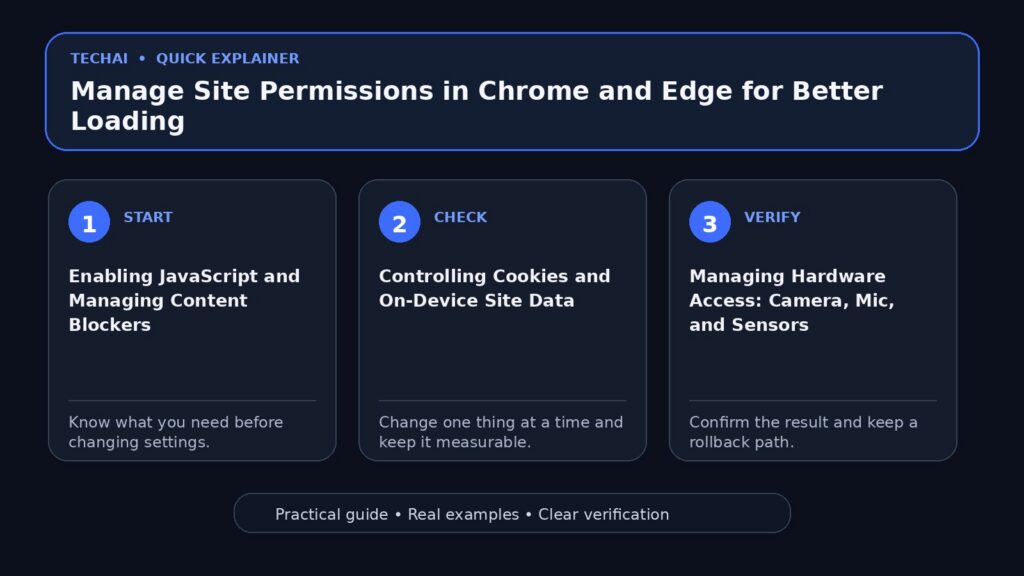
Enabling JavaScript and Managing Content Blockers
One of the most common reasons a website fails to load is the absence of JavaScript. As noted in official client challenges, when JavaScript is disabled, a required part of the site cannot execute, leading to a complete halt in functionality. JavaScript is the engine behind interactive elements, and while some users disable it for security, most modern web applications require it to be active. If you encounter a message stating 'JavaScript is disabled,' you must navigate to your browser's site settings to re-enable it specifically for that domain.

Beyond JavaScript, ad blockers and network-level filters can also prevent sites from loading correctly. Chrome and Edge both include built-in mechanisms to manage how ads and intrusive content are handled. If a site appears broken, it may be because a critical script was misidentified as an advertisement. In these cases, turning off the browser's native ad blocker for that specific site can often resolve the issue. This is a safer alternative to disabling your security tools globally, as it limits the exposure to just the site you are currently troubleshooting.
- Check for 'JavaScript is disabled' warnings in the browser viewport.
- Identify if a site's core functionality is tied to an external script.
- Toggle site-specific ad blocking settings in the address bar.
- Verify if a network-level issue is mimicking a browser setting error.
- Use the 'Site Settings' menu to allow JavaScript on a per-site basis.
Controlling Cookies and On-Device Site Data
Cookies and on-device site data are fundamental to how browsers remember your preferences and login states. Chrome provides specific controls for 'on-device site data,' which allows websites to store information directly on your computer to improve performance and offline capabilities. However, if this data becomes corrupted or if the browser is set to block all cookies, you may find yourself unable to sign in or progress through multi-step forms. Managing these settings involves deciding which sites are allowed to save data and for how long.
In Microsoft Edge, cookie management is closely tied to privacy and tracking prevention. You can choose to delete cookies every time you close the browser or allow them only for specific trusted sites. If a website keeps refreshing or fails to save your progress, it is often a sign that the browser is blocking essential first-party cookies. By adjusting the 'Cookies and site data' permissions, you can ensure that the site has the necessary local storage access to function while still blocking intrusive third-party tracking cookies that follow you across the web.
- Access 'Delete, allow, and manage cookies' in Chrome's privacy menu.
- Use Edge's 'Delete your cookies' tool to clear corrupted session data.
- Enable 'on-device site data' for web apps that require offline access.
- Distinguish between essential first-party cookies and third-party trackers.
- Set exceptions for sites that must keep you logged in between sessions.
Managing Hardware Access: Camera, Mic, and Sensors
Modern websites often require access to your hardware to provide services like video calls or voice recording. Chrome and Edge provide granular controls for your microphone and camera, ensuring that no site can access these devices without your explicit permission. When a site fails to detect your hardware, it is usually because the permission was previously denied or the browser's global settings are too restrictive. You can adjust the microphone volume and toggle camera access directly within the site permissions menu.
In addition to audio and video, browsers now support advanced hardware interactions. Chrome, for instance, allows you to give sites permission to use MIDI devices, which is essential for web-based music production. It also supports connections to USB, Serial, and HID (Human Interface Device) devices. If you are using a specialized web tool that interacts with external hardware, you must ensure that the specific device permission is granted in the browser settings, as these are often blocked by default for security reasons.
- Grant or revoke camera and microphone access via the lock icon in the address bar.
- Adjust microphone volume settings within the browser's media controls.
- Manage permissions for MIDI devices for creative web applications.
- Authorize USB and Serial device connections for specialized hardware tools.
- Check HID device permissions for external controllers and peripherals.
Privacy Shields and Tracking Prevention
Microsoft Edge features a robust 'Tracking Prevention' system designed to protect users from being followed across the internet. This system has multiple levels—Basic, Balanced, and Strict. While 'Strict' offers the most privacy, it is also the most likely to cause loading issues by blocking scripts that the site needs to function. If a site's layout is missing images or buttons, lowering the tracking prevention level for that specific site can often fix the problem without lowering your protection on other websites.

Chrome approaches privacy through features like Safe Browsing and 'Privacy Sandbox' initiatives. Safe Browsing protects you from unsafe sites and downloads by cross-referencing URLs against a known list of malicious entities. If Chrome blocks a site you believe is safe, you can manage these warnings in the security settings. Understanding the difference between a privacy block (like tracking prevention) and a security block (like Safe Browsing) is vital for troubleshooting why a page won't display correctly.
- Switch between Basic, Balanced, and Strict tracking prevention in Edge.
- Identify when tracking prevention is breaking a site's visual layout.
- Use Chrome's Safe Browsing to manage warnings about unsafe sites.
- Audit 'Privacy Sandbox' settings to control how your data is shared.
- Disable tracking protection temporarily to test site functionality.
Handling Pop-ups, Redirects, and Notifications
Pop-up blockers are a standard feature in both Chrome and Edge, intended to stop intrusive advertisements. However, many legitimate sites use pop-ups for essential functions, such as login windows, file downloads, or help chats. If you click a button and nothing happens, it is highly likely the browser blocked a pop-up. Both browsers provide a visual indicator in the address bar when a pop-up is blocked, allowing you to 'Always allow' pop-ups from that specific source.
Notifications are another permission that can affect your experience. While not usually a cause for loading errors, mismanaged notification permissions can lead to a cluttered and distracting browsing environment. You can manage which sites are allowed to send you alerts and even use 'quiet messaging' to prevent sites from interrupting you. If a site requires notifications for its core service (like a web-based email client), ensuring this permission is granted is necessary for the site to be 'fully loaded' in terms of its intended utility.
- Look for the 'Pop-up blocked' icon in the right side of the address bar.
- Add trusted sites to the 'Allow' list for pop-ups and redirects.
- Manage desktop notification permissions to reduce browser clutter.
- Enable 'Quiet messaging' to block intrusive notification requests.
- Distinguish between malicious redirects and functional site pop-ups.
Troubleshooting Connection and Loading Errors
When a site simply refuses to load, the issue may lie in the browser's cache or its connection settings. Edge and Chrome both offer tools to 'Clear your cache' or 'Delete browsing data,' which removes temporary files that may be causing conflicts. This is often the first step in troubleshooting 'Fix connection and loading errors.' If a site works in Incognito or Guest mode but not in your main profile, the problem is likely a corrupted cache or a conflicting extension.
Network-level issues can also be a factor. Chrome's 'Fix problems with web content' guide suggests checking your internet connection and ensuring that the browser is not being blocked by a firewall or proxy. If you have recently changed your DNS settings or are using a VPN, these can interfere with how the browser resolves site addresses. Resetting your browser settings to their original defaults is a powerful 'last resort' that can clear out complex configuration errors that manual auditing might miss.
- Use Incognito or Guest mode to rule out extension conflicts.
- Clear 'Cached images and files' to resolve visual glitches.
- Check the 'Secure connection' status via the lock icon.
- Verify network settings if the browser reports a 'Connection timed out' error.
- Reset Chrome or Edge settings to default to fix persistent loading issues.
Advanced Site Settings and Experimental Features
For power users, browsers offer advanced settings that control how sites interact with your system at a deeper level. This includes permissions for 'Automatic downloads,' 'Background sync,' and 'Payment handlers.' Chrome also allows you to manage 'Chrome Actions' and 'Gemini' AI features that can assist with site navigation. If a site feels sluggish or fails to perform background tasks, checking the 'Background sync' and 'Performance' settings can provide a solution.
Experimental features, often found in 'Chrome Flags' or Edge's 'Dev' channels, allow you to test new web capabilities before they are officially released. While these can improve performance, they can also cause instability. If you have enabled experimental flags and start experiencing site-specific crashes, disabling these features should be your first troubleshooting step. Always remember that site-specific permissions override global settings, giving you the flexibility to experiment on one site while maintaining a stable environment for others.
- Manage 'Automatic downloads' to prevent multiple file prompts.
- Enable 'Background sync' for web apps that need to update data in the background.
- Audit 'Payment info' and 'Virtual cards' permissions for secure shopping.
- Use 'Chrome Flags' to test experimental site-loading optimizations.
- Configure 'Performance' settings to prioritize active tabs and sites.
Key takeaways
- JavaScript is essential for most modern sites; if disabled, core features will fail to load.
- Site-specific permissions allow you to grant hardware access (camera, mic) only to trusted domains.
- Edge's Tracking Prevention and Chrome's Safe Browsing are primary tools for balancing privacy and site functionality.
- Clearing the browser cache and cookies is the most effective first step for resolving 'broken' page layouts.
- Advanced permissions like USB, Bluetooth, and MIDI access are available in Chrome for specialized web applications.
Common mistakes to avoid
- Disabling JavaScript globally, which breaks the majority of interactive websites.
- Ignoring the 'Pop-up blocked' notification on sites that require a new window for login or downloads.
- Setting Tracking Prevention to 'Strict' in Edge and forgetting to whitelist essential work-related sites.
- Assuming a site is 'down' before testing it in Incognito mode to rule out extension or cache interference.
Useful TechAI links
FAQ
Why does a website say my browser is unsupported or JavaScript is off?
This usually happens because the site's required scripts are being blocked by your security settings or an extension. Check your 'Site Settings' to ensure JavaScript is set to 'Allowed' and try disabling any active ad blockers for that specific page.
What is the difference between 'Clear Browsing Data' and 'Reset Settings'?
Clearing browsing data removes temporary files like history, cookies, and cache. Resetting settings is more comprehensive; it returns your startup page, new tab page, search engine, and pinned tabs to their original defaults, and disables all extensions.
How do I know if a site's connection is secure?
Look for the lock icon in the address bar. Clicking this icon will show you if the connection is secure, what cookies are in use, and allow you to quickly access the site's specific permission settings.
Can I allow a site to access my USB or Bluetooth devices?
Yes, Chrome supports 'WebUSB' and 'Web Bluetooth.' When a site requests access, a prompt will appear. You can manage these later in the 'Privacy and security' section of your browser settings under 'Additional permissions.'