
Modern web browsing relies on a complex interaction between local browser settings, network configurations, and site-specific permissions. When a website fails to load or displays a 'Client Challenge' error, the cause is often a conflict between the browser's security protocols and the site's required assets. These issues frequently manifest as broken layouts, missing interactive elements, or total connection failures that prevent the page from rendering. Understanding how to navigate the internal settings of browsers like Google Chrome, Microsoft Edge, and Mozilla Firefox is essential for restoring functionality without compromising your digital security.
This guide provides a systematic approach to troubleshooting these common errors by focusing on site-specific data management and permission controls. By isolating variables—such as cached files, third-party extensions, and script permissions—users can identify whether a problem stems from a temporary local glitch or a deeper configuration issue. We will explore the practical steps for clearing browsing data, managing JavaScript settings, and utilizing diagnostic modes like Incognito or Guest browsing to ensure a seamless and secure web experience.
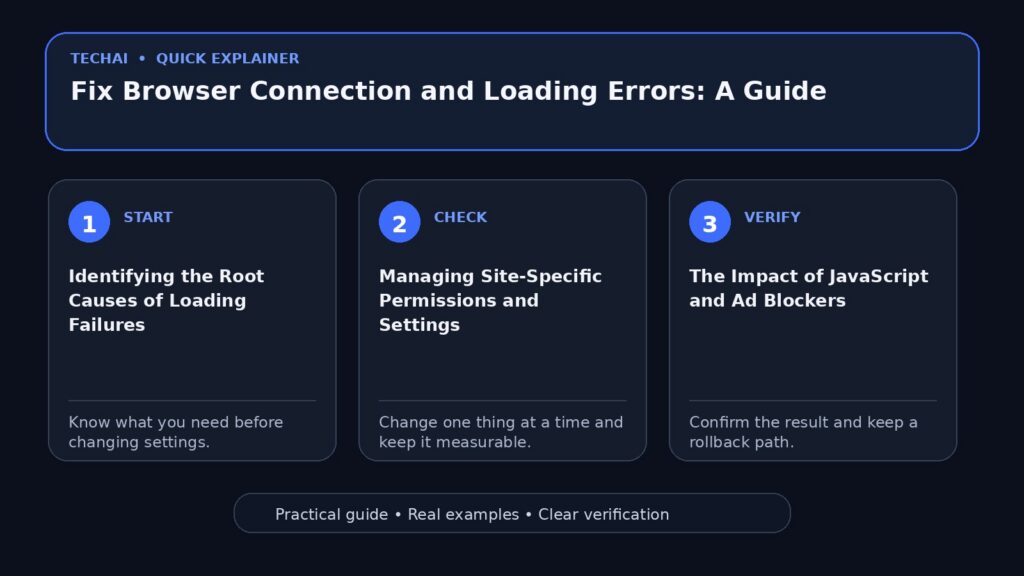
Identifying the Root Causes of Loading Failures
When a browser fails to load a 'required part' of a website, the error message often points toward three primary culprits: browser extensions, network issues, or internal browser settings. A common indicator of these problems is a prompt stating that JavaScript is disabled or that a connection cannot be established. JavaScript is a fundamental component for most modern web applications; without it, interactive elements like menus, forms, and media players will fail to initialize.

Network issues may also be localized to the browser's handling of specific protocols. For instance, if a site requires a secure connection but the browser detects a mismatch in security certificates, it may block the content entirely. Similarly, aggressive ad blockers or tracking prevention settings can inadvertently flag essential site scripts as intrusive, leading to a partial or total failure of the page to display correctly. Identifying whether the issue is site-wide or specific to one page is the first step in effective troubleshooting.
Before diving into deep settings, it is helpful to check if the issue persists across different browsers. If a site loads in Microsoft Edge but fails in Google Chrome, the problem is likely a specific setting or extension within Chrome. If the site fails across all platforms, the issue may reside with your network connection or the website's server itself.
- Check for 'JavaScript is disabled' warnings in the browser header.
- Verify if the site works in a different browser to isolate the cause.
- Look for 'Connection not secure' icons in the address bar.
- Determine if the error occurs on a specific page or the entire domain.
- Assess if the issue started after installing a new browser extension.
Managing Site-Specific Permissions and Settings
Browsers like Google Chrome and Microsoft Edge allow users to manage permissions on a per-site basis. This is crucial for sites that require access to hardware or specific data types to function. Site settings control everything from location access and camera usage to more technical permissions like MIDI device access or Bluetooth connections. If a site is not loading correctly, it may be because a required permission has been blocked or set to 'Ask' but the prompt was missed.
To adjust these, users can typically click the lock or settings icon next to the URL in the address bar. This menu provides immediate access to toggle permissions for that specific domain. For example, a video conferencing site will fail if the microphone and camera permissions are disabled. Similarly, some sites require 'on-device site data' to be allowed to store temporary information necessary for the session's continuity.
Beyond hardware, site settings also govern how content like pop-ups, redirects, and intrusive ads are handled. While blocking these is generally a security best practice, some legitimate sites use pop-ups for login windows or document viewers. If a site feels 'stuck' after you click a button, checking the pop-up blocker settings for that specific site is a common resolution.
- Access site settings via the lock icon in the address bar.
- Enable or disable camera, microphone, and location permissions.
- Manage MIDI, Bluetooth, and USB device connections for specific sites.
- Toggle pop-up and redirect settings if a site fails to open new windows.
- Adjust 'on-device site data' to allow or block local storage.
The Impact of JavaScript and Ad Blockers
JavaScript is the engine behind web interactivity. When a site displays a 'Client Challenge' or fails to load dynamic content, it is often because JavaScript has been disabled globally or for that specific site. While disabling JavaScript can improve security and speed on some sites, it breaks the functionality of most modern web applications. Users should ensure that JavaScript is set to 'Allowed' in their browser's site settings to avoid these errors.
Ad blockers and tracking prevention tools are another frequent source of loading errors. These tools work by identifying and blocking scripts that match known advertising or tracking databases. However, these databases can sometimes include 'false positives'—scripts that are actually necessary for the site to function. If a site appears broken or elements are missing, disabling your ad blocker for that specific domain is a recommended diagnostic step.
Microsoft Edge and Google Chrome both include built-in protections, such as 'SmartScreen' or 'Safe Browsing,' which monitor for unsafe sites. While these are vital for security, they can occasionally block a site if it has been incorrectly flagged. Understanding how to manage these warnings allows you to proceed to a site you trust while remaining aware of the potential risks identified by the browser.
- Ensure JavaScript is enabled in the 'Privacy and security' section of settings.
- Disable third-party ad blockers temporarily to test site functionality.
- Check if 'Tracking Prevention' in Edge is set to a level that blocks essential scripts.
- Look for 'Safe Browsing' warnings that might be preventing page loads.
- Add trusted sites to an 'Allow' list within your ad blocker settings.
Clearing Cache and Browsing Data Effectively
Browsers store images, scripts, and other parts of websites in a 'cache' to speed up loading times on subsequent visits. However, if the website updates its code but your browser continues to use the old, cached version, the site may fail to load or behave erratically. Clearing the cache forces the browser to download the most recent version of the site's assets from the server.

When clearing data, you have the option to select specific time ranges, such as 'Last hour,' 'Last 24 hours,' or 'All time.' For persistent loading errors, clearing 'All time' data is often the most effective. It is important to distinguish between 'Cached images and files' and 'Cookies and other site data.' Clearing cookies will sign you out of most websites, while clearing the cache generally does not affect your login status.
In Google Chrome and Microsoft Edge, this process is found under the 'Privacy and security' or 'History' menus. Users can choose to clear browsing history, download history, cookies, and cached images. If you are experiencing issues with a specific site, some browsers allow you to clear data for just that site rather than wiping your entire browsing history, which is a more surgical approach to troubleshooting.
- Navigate to 'Clear browsing data' in the browser settings menu.
- Select 'Cached images and files' to resolve version mismatch issues.
- Choose the 'All time' range for a comprehensive data reset.
- Be aware that clearing 'Cookies' will sign you out of most accounts.
- Use site-specific data clearing to avoid losing data on other websites.
Using Incognito and Guest Modes for Diagnosis
Incognito mode (Chrome) and InPrivate browsing (Edge) are powerful diagnostic tools. When you open a window in these modes, the browser operates without using your existing cookies or most of your installed extensions. If a website that was previously failing to load suddenly works perfectly in Incognito mode, you have successfully narrowed the problem down to either a corrupted cookie or a faulty extension.
Guest mode is similar but even more restrictive, providing a completely fresh profile that doesn't share any settings with your main user account. This is particularly useful for determining if a browser-wide setting—like a custom proxy or a modified flag—is causing the connection error. Since Guest mode doesn't save any browsing history or data, it provides a 'clean slate' for testing.
If the site still fails to load in Incognito or Guest mode, the issue is likely not related to your local data or extensions. In this case, the problem is more likely related to your network connection, your DNS settings, or the website's server itself. This simple test saves significant time by immediately ruling out a large category of potential local conflicts.
- Open an Incognito or InPrivate window to bypass extensions and cookies.
- Use Guest mode to test the site with a completely fresh browser profile.
- If the site works in Incognito, disable extensions one by one to find the culprit.
- Check if the issue is related to saved passwords or autofill data in your main profile.
- Rule out local data corruption if the site fails in all modes.
Managing Cookies and On-Device Site Data
Cookies are small files that websites use to remember your preferences, login status, and session information. While they are essential for a personalized web experience, corrupted or outdated cookies can cause 'Looping' errors, where a site repeatedly tries to redirect you or fails to authenticate your session. Managing these cookies is a key part of resolving persistent loading issues.
Modern browsers now offer more granular control over 'on-device site data.' This includes not just traditional cookies, but also local storage used by web apps. In Chrome, you can choose to 'Delete data from sites when you close all windows,' which can help prevent the accumulation of corrupted data over time. You can also see exactly which sites have stored data on your device and remove them individually.
Third-party cookies—those set by a domain other than the one you are currently visiting—are often blocked by default in modern browsers to enhance privacy. However, some sites rely on these for cross-site functionality, such as embedded videos or payment processors. If a specific feature on a site isn't loading, check if your browser is blocking third-party cookies and consider adding an exception for that site.
- View and delete cookies for individual sites in the browser settings.
- Enable 'Block third-party cookies' for better privacy, but watch for site breakage.
- Use 'Delete data on close' to maintain a clean browser state.
- Check for 'on-device site data' permissions if a web app fails to save progress.
- Clear specific cookies if you encounter 'Too many redirects' errors.
Resetting Browser Settings to Default
When all other troubleshooting steps fail, resetting the browser to its default settings is the final local solution. This action reverts almost all customizations you have made to the browser since installation. It is a 'nuclear' option that can resolve deep-seated configuration errors that are difficult to find manually, such as modified internal flags or complex permission conflicts.
A reset typically performs several actions: it changes the default search engine back to the original, resets the homepage and startup pages, and clears the 'New Tab' page. It also disables all extensions and clears temporary data like cookies. However, it is important to note that a reset usually preserves your bookmarks, browsing history, and saved passwords, so you won't lose your most critical personal data.
Before performing a reset, ensure you have noted any specific configurations you need, such as custom search shortcuts or specific site permissions you've granted. After the reset, you will need to re-enable your extensions one by one. This is actually a beneficial part of the process, as it allows you to verify that each extension is compatible with the browser's current version and isn't causing the original loading error.
- Locate 'Reset settings' in the advanced section of the browser menu.
- Understand that a reset disables extensions but does not delete them.
- Confirm that bookmarks, history, and passwords will remain intact.
- Be prepared to re-configure your homepage and default search engine.
- Use this step only after cache clearing and Incognito testing have failed.
Troubleshooting Extensions and Third-Party Apps
Extensions are one of the most common causes of browser instability and loading errors. Because extensions have the ability to modify the content of web pages, a poorly coded or outdated extension can interfere with a site's scripts. This is especially true for extensions that modify the UI, block ads, or manage passwords. If a site fails to load, the extensions are the first place to look after the cache.
The most effective way to troubleshoot extensions is the 'elimination method.' Start by disabling all extensions and then reloading the problematic website. If the site loads, enable your extensions one at a time, refreshing the site after each one. When the site fails again, you have identified the specific extension causing the conflict. You can then check for updates for that extension or look for an alternative.
In addition to browser extensions, third-party software on your computer—such as antivirus programs or firewalls—can also interfere with browser connections. These programs sometimes intercept web traffic to scan for threats, which can cause delays or blockages. If you've ruled out internal browser settings and extensions, temporarily disabling your security software's 'web protection' feature can help determine if it is the source of the connection error.
- Disable all extensions to see if the loading error disappears.
- Re-enable extensions individually to identify the specific cause of failure.
- Check the extension's 'Details' page for available updates.
- Remove extensions that haven't been updated recently or are no longer needed.
- Verify if external security software is blocking the browser's web traffic.
Key takeaways
- JavaScript must be enabled for most modern websites to load and function correctly.
- Incognito or InPrivate mode is the fastest way to determine if an extension or cookie is causing the issue.
- Clearing the browser cache resolves errors caused by outdated or mismatched site files.
- Site-specific permissions (camera, location, pop-ups) can be managed individually via the address bar lock icon.
- Resetting browser settings is a safe way to fix deep configuration issues without losing bookmarks or passwords.
Common mistakes to avoid
- Clearing all browsing history when only the cache needed to be emptied, resulting in lost login sessions.
- Assuming a site is 'down' before testing it in a different browser or Incognito mode.
- Leaving too many unused extensions active, which increases the likelihood of script conflicts and slow loading.
- Ignoring browser update prompts, which can lead to compatibility issues with newer web technologies.
Useful TechAI links
FAQ
Why does a site work in Incognito mode but not in a normal window?
This usually indicates that a browser extension or a corrupted cookie in your main profile is interfering with the site. Since Incognito mode disables most extensions and starts with a clean set of cookies, it bypasses these local conflicts.
Will resetting my browser delete my bookmarks and saved passwords?
No, in most modern browsers like Chrome and Edge, a settings reset is designed to keep your bookmarks, saved passwords, and browsing history intact. It primarily targets settings, startup pages, and extensions.
What is the difference between clearing cache and clearing cookies?
Clearing the cache removes stored website files like images and scripts to ensure you see the latest version of a site. Clearing cookies removes the files that keep you logged in and remember your site preferences.
How do I know if my ad blocker is breaking a website?
If a site loads but is missing buttons, images, or has a broken layout, try disabling your ad blocker for that specific site. If the missing elements reappear, the ad blocker's filters were likely too aggressive.
What should I do if I get a 'JavaScript is disabled' error even though it is enabled?
This can happen if an extension is blocking scripts or if your browser's security settings are set too high. Try disabling extensions or checking if the site is on a 'Block' list in your JavaScript settings.