Small and medium-sized businesses (SMBs) are the backbone of national critical infrastructure, often serving as essential suppliers or operators for services the public relies on daily. However, as cyber threats evolve with increasing speed and intelligence, these organizations face a growing risk from sophisticated attacks targeting weak spots in software and hardware. To combat this, the Cybersecurity and Infrastructure Security Agency (CISA) has introduced the '3Rs' framework—Reduce, Replace, and Recover—specifically designed to help organizations secure their systems and networks against modern disruptions.
Implementing the 3Rs is not just about buying new software; it is a strategic approach to managing the lifecycle of technology and the breadth of your digital footprint. By focusing on reducing attack surfaces, replacing aging end-of-support (EOS) devices, and building rapid recovery capabilities, small businesses can sustain operations even when faced with significant cyber incidents. This guide provides a practical roadmap for applying these principles to protect your business and the critical infrastructure it supports.
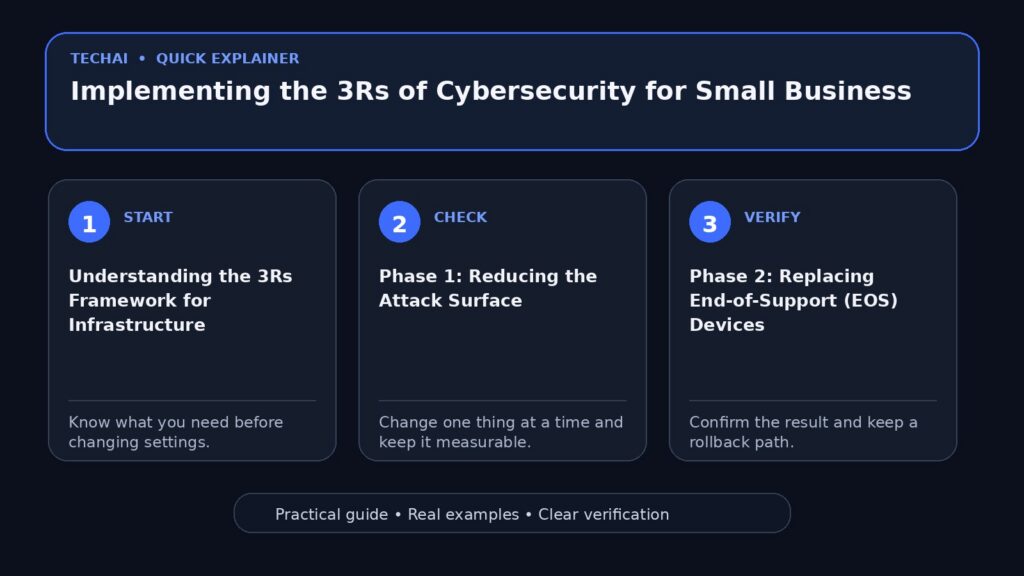
Understanding the 3Rs Framework for Infrastructure
The 3Rs framework—Reduce, Replace, and Recover—is a specialized strategy for organizations that own or operate critical infrastructure. It moves beyond basic cyber hygiene to address the structural vulnerabilities that hackers often exploit. In an era where 'Super Intelligence' and evolving technologies accelerate the rate at which vulnerabilities are discovered, this framework provides a prioritized method for hardening defenses. This is particularly vital for small and medium businesses that may not have the resources of a large corporation but still play a significant role in national security and public safety.

Each 'R' represents a specific phase of risk management. 'Reduce' focuses on minimizing the opportunities for an attacker to enter your network by shrinking the digital footprint. 'Replace' addresses the physical and software-based risks of legacy equipment that no longer receives security updates, specifically targeting edge devices. Finally, 'Recover' ensures that if a breach does occur, the business can return to normal operations with minimal downtime, thereby protecting the broader economy and national security from cascading failures.
By adopting this framework, SMBs can align their security posture with federal standards such as CISA's Binding Operational Directives. These directives emphasize that the speed of modern threats requires a proactive rather than reactive stance. Instead of waiting for an incident to occur, the 3Rs encourage a continuous cycle of assessment and improvement, ensuring that the most critical entry points are always shielded and that the organization is prepared for the next frontier of technological disruption.
- Reduce: Minimize the digital attack surface to limit entry points.
- Replace: Transition away from end-of-support (EOS) edge devices.
- Recover: Develop and test plans to sustain operations during disruptions.
- Context: Specifically vital for SMBs in the critical infrastructure supply chain.
Phase 1: Reducing the Attack Surface
Reducing the attack surface is the first line of defense. This involves identifying every point where an unauthorized user could potentially access your data or systems and closing unnecessary gaps. For small businesses, this often means auditing cloud services, remote access points, and connected hardware to ensure only essential services are exposed to the internet. The goal is to make the target as small as possible, leaving fewer doors open for automated scanning tools and malicious actors to find.
CISA recommends several core actions to achieve this reduction. Implementing multifactor authentication (MFA) is one of the most effective ways to secure access points, as it prevents attackers from using stolen passwords alone to gain entry. Additionally, using a password manager and strong, unique passwords across all accounts ensures that a single compromised credential does not lead to a total network breach. These steps are foundational and should be applied to every administrative and remote account within the organization.
Beyond authentication, businesses should implement system logging and data encryption. Logging allows for the monitoring of unauthorized access attempts, providing an early warning system for potential breaches. Encrypting sensitive data both at rest and in transit ensures that even if a thief manages to exfiltrate information, it remains unreadable and useless. For eligible government-related entities, transitioning to a .gov domain can also increase trust and provide a more secure foundation for digital communications.
- Enable multifactor authentication (MFA) on all administrative accounts.
- Use logging on your systems to monitor for unauthorized access attempts.
- Encrypt sensitive data both at rest and in transit.
- Apply for a .gov domain if your organization is a government entity.
Phase 2: Replacing End-of-Support (EOS) Devices
End-of-support (EOS) devices, particularly edge devices like routers, firewalls, and gateways, represent a significant risk to critical infrastructure. When a manufacturer stops providing security updates, any new vulnerabilities discovered in that hardware remain unpatched forever. Hackers actively target these 'weak spots' because they know the door is permanently unlocked. For an SMB, an EOS device is often the weakest link that allows an attacker to bypass otherwise strong security measures.
CISA’s Binding Operational Directives (BOD) emphasize the need to prioritize security updates based on risk. For small businesses, this means maintaining a comprehensive inventory of all hardware and software to track their support status. If a device is no longer supported by the vendor, it must be replaced with a modern, 'secure by design' alternative. These newer products often feature automatic updates and real-time threat detection, which significantly reduces the maintenance burden on small IT teams.
When selecting replacement hardware, businesses should look for products that are secure by default. This means the manufacturer has integrated security as a foundation rather than an add-on. Features like built-in encryption, ML-powered security guards, and privacy-respecting data practices are essential. By consulting resources like CISA's Known Exploited Vulnerabilities (KEV) catalog, businesses can identify which of their current devices are most at risk and prioritize their replacement schedule accordingly.
- Identify all edge devices that have reached end-of-support status.
- Prioritize the replacement of internet-facing devices.
- Transition to products that offer built-in security and automatic updates.
- Review CISA's KEV catalog to identify high-risk hardware.
Phase 3: Building Rapid Recovery Capabilities
Recovery is the ability to sustain operations and bounce back quickly after a system disruption. Resilience is not just about preventing attacks, but about being prepared for the moment they succeed. For critical infrastructure operators, a delay in recovery can have cascading effects on public safety and the economy. Rapid recovery ensures that even if a system is compromised, the essential functions of the business can continue with minimal interruption.

A robust recovery strategy relies on frequent data backups and a well-documented incident response plan. These backups should be stored securely, ideally in an encrypted format, and tested regularly to ensure they can be restored without error. A backup that has never been tested is a significant risk during a real crisis. Having a formal plan in place allows your team to act decisively, reducing the 'time to recovery' and minimizing the impact on your customers and the community.
Furthermore, businesses should establish clear communication channels for reporting cyber incidents to CISA. Reporting is a critical step in the recovery process as it allows federal experts to provide assistance and helps protect other organizations from similar threats. Your recovery plan should also include manual workarounds for critical services. If digital systems fail, having a non-digital or alternative method to maintain operations can be the difference between a temporary setback and a total business shutdown.
- Maintain regular, encrypted backups of all critical business data.
- Develop a formal incident response plan and conduct regular drills.
- Establish clear channels for reporting cyber incidents to CISA.
- Ensure the recovery plan includes manual workarounds for critical services.
Securing the Human Element and Culture
Technology alone cannot protect a business; the people operating the systems must also be vigilant. Phishing remains one of the most common ways for attackers to bypass technical controls. Educating employees on how to avoid and report phishing scams is a fundamental component of the 'Reduce' strategy. When staff members are trained to recognize suspicious links and verify sender identities, they become an active part of the organization's defense mechanism.
Cybersecurity is a collective responsibility that requires innovators, communicators, and problem-solvers. By fostering a culture of security awareness, small businesses can turn their staff into a human firewall. This includes teaching employees to use secure tools like password managers to eliminate the habit of reusing passwords across different platforms. Encouraging participation in initiatives like 'Cyber Careers Week' can also inspire staff to take a deeper interest in security roles, strengthening the internal expertise of the company.
Small businesses should also utilize ready-made training materials, such as the Cybersecurity Awareness Month toolkit provided by CISA. These resources offer graphics and presentations that can be used to build internal campaigns without requiring a large budget. By making security a regular part of the conversation, businesses can ensure that every team member understands their role in protecting the organization's digital assets and the critical infrastructure it supports.
- Train staff to recognize and report suspicious emails and phishing.
- Encourage the use of password managers to eliminate password reuse.
- Promote 'Cyber Careers Week' to inspire staff interest in security.
- Utilize CISA’s toolkit for ready-made training and messaging.
Leveraging No-Cost Security Services
Many small businesses struggle with cybersecurity due to limited budgets and technical staff. However, there are numerous high-quality, no-cost resources available from government and industry leaders. CISA offers cyber hygiene services that include vulnerability scanning and web application scanning. these services help organizations identify their most pressing risks by simulating the scanning techniques used by attackers, allowing the business to fix vulnerabilities before they are exploited.
Major technology providers also offer built-in security features that are 'secure by default.' For example, using platforms that provide real-time threat detection, encrypted messaging, and automatic updates can significantly lower the barrier to entry for robust security. Utilizing these tools allows SMBs to achieve a high level of protection without the need for a massive internal IT department. These products are designed to protect privacy and security as a foundation, ensuring that safety is not an optional feature.
In addition to scanning services, businesses should monitor CISA alerts and advisories for real-time information on emerging threats. Staying informed about the latest tactics used by hackers allows small businesses to adjust their 'Reduce' and 'Replace' strategies dynamically. By combining no-cost government services with secure-by-design commercial products, SMBs can build a defense-in-depth strategy that is both effective and economically sustainable.
- Sign up for CISA’s no-cost vulnerability scanning services.
- Download the Cybersecurity Awareness Month toolkit for training.
- Use 'Safer by Design' products that prioritize privacy and security.
- Monitor CISA alerts and advisories for real-time threat info.
The Role of AI and Future Threats
The landscape of cybersecurity is shifting as Artificial Intelligence (AI) and quantum computing emerge. While AI can help hackers find vulnerabilities faster and automate phishing campaigns, it is also being used to build more resilient defenses. Leading technology companies are implementing Secure AI Frameworks (SAIF) to ensure that AI-powered tools remain safe and respect user privacy. These frameworks provide a roadmap for using AI responsibly while maintaining a high level of security.
Small businesses must stay informed about these technological shifts to remain competitive and secure. As 'Super Intelligence' accelerates the pace of attacks, the 3Rs framework becomes even more critical. Organizations that fail to replace EOS devices or reduce their attack surface today will find themselves increasingly vulnerable to AI-driven automated exploits in the near future. Preparing for the next frontier of quantum innovation requires maintaining agile security policies that can adapt to new types of encryption and data protection needs.
Executive orders are increasingly focusing on national policy frameworks for AI innovation and security. SMBs should pay attention to these developments as they often signal upcoming regulatory changes or new standards for critical infrastructure. By adopting ML-powered security tools now, businesses can detect threats in real-time and respond with the same speed as their attackers. The future of cybersecurity is a race of technology, and the 3Rs provide the necessary foundation to stay in that race.
- Stay updated on Executive Orders regarding AI and security.
- Adopt ML-powered security tools for real-time threat detection.
- Prepare for quantum innovation by maintaining agile security policies.
- Focus on 'Secure by Default' configurations to mitigate AI exploits.
Key takeaways
- The 3Rs framework (Reduce, Replace, Recover) is essential for critical infrastructure resilience.
- End-of-support (EOS) edge devices are high-priority targets and must be replaced immediately.
- Multifactor authentication (MFA) and password managers are non-negotiable for reducing attack surfaces.
- Rapid recovery depends on tested incident response plans and secure, encrypted data backups.
- No-cost services from CISA can help SMBs identify vulnerabilities without additional expense.
Common mistakes to avoid
- Continuing to use edge devices like routers and firewalls after they have reached end-of-support.
- Failing to test data backups, leading to failure during an actual recovery attempt.
- Relying on passwords alone without enabling multifactor authentication (MFA) for all accounts.
- Assuming that small businesses are too small to be targets of critical infrastructure attacks.
Check your website next
- Check your website free
- Full Website Audit — $9
- Website Growth Bundle — $39
- Website Fix Implementation — from $149
FAQ
What are 'edge devices' and why are they risky?
Edge devices are hardware like routers, firewalls, and gateways that sit between your internal network and the internet. They are risky because if they reach end-of-support, they no longer receive security patches, making them permanent 'weak spots' for hackers to exploit.
How often should my business back up its data?
Data should be backed up regularly, with the frequency depending on how much data your business can afford to lose. CISA recommends encrypting these backups and ensuring they are part of a broader incident response plan that is tested frequently.
Where can I report a cyber incident?
You should report cyber incidents directly to CISA. They provide resources and assistance for organizations of all sizes to help manage the impact of an attack and prevent further disruption to critical services.
What does 'Secure by Design' mean for my business?
It means choosing products where security is a foundational element, not an add-on. These products typically include automatic updates, built-in encryption, and privacy controls that are enabled by default, reducing the burden on your staff.